



TL;DR: What should you do if you’re facing Barclays redundancy?Barclays redundancy news broke on 22 October 2026: the bank expects to cut about 5,000 roles from this year’s cost actions, around 60% of them in support functions, developers included. If your role is on the list, first know your floor: statutory redundancy pay needs two years’ service and is capped at £751 a week and £22,530 in total, and statutory pay under £30,000 isn’t taxed. Then use the consultation weeks to test whether your bank skills can become a business: talk to ten possible clients, sell one paid pilot, and register with HMRC only once you start trading.
Let’s start with what you’re owed, then look at how to turn ten or twenty years of bank experience into your own income.
Who is affected by the Barclays job cuts?
Barclays’ results presentation says about 5,000 full-time roles, roughly 5% of its employees, with around 60% of the actions in support functions “including developers”. Press reports say about 1,000 went in the first half of 2026 and the rest go by the end of the year. Barclays UK, the high-street bank, carries the largest share of this year’s cost actions: the bank says call-centre volumes fell 10% and staff per branch fell about 10% in the past year. Barclays hasn’t said which countries or sites are affected.
The cuts are “subject to collective and individual consultation as required”, Barclays says. That consultation period is your window to plan, and it’s longer than most people think.
What are your redundancy rights in the UK?
Two practical points. Statutory pay is a floor, and if you’re offered a settlement agreement, get independent advice before you sign it. And Jobcentre Plus runs a Rapid Response Service for people facing redundancy, with help on CVs, job search, benefits and training.
Should you look for a new job or start your own business?
Both, for a few weeks. The consultation period, your notice and your paid job-search time give you a rare stretch where you’re still paid and allowed to look around. Use half of it on applications and half on a small business test. By the end you’ll know which one pays.
Bank staff tend to undersell what they know. Five years in a regulated bank means you’ve lived through audits, risk reviews, change programmes and complaints processes that small companies have never seen. Fintech startups, small lenders, accountants and growing e-commerce shops pay for exactly that. Some offers that fit bank backgrounds:
- Developers: contract or fractional work for fintech startups that need someone who understands payments, security reviews and audit trails. Our post on developer relations for non-technical founders shows what those founders look for.
- Operations and change people: documenting processes and setting up simple automations for small businesses. Start with the tools in automation for women entrepreneurs.
- Risk, compliance and complaints staff: compliance checklists, GDPR clean-ups and complaint handling for small firms, as in our female founder’s compliance guide.
- Call-centre and branch staff: customer service set-up, training and outsourced support for small online shops that are drowning in tickets.
- Anyone with a niche: mortgage process, small-business lending, fraud checks. A narrow offer sells faster than “consultant”.
What does a 30-day plan look like after a redundancy notice?
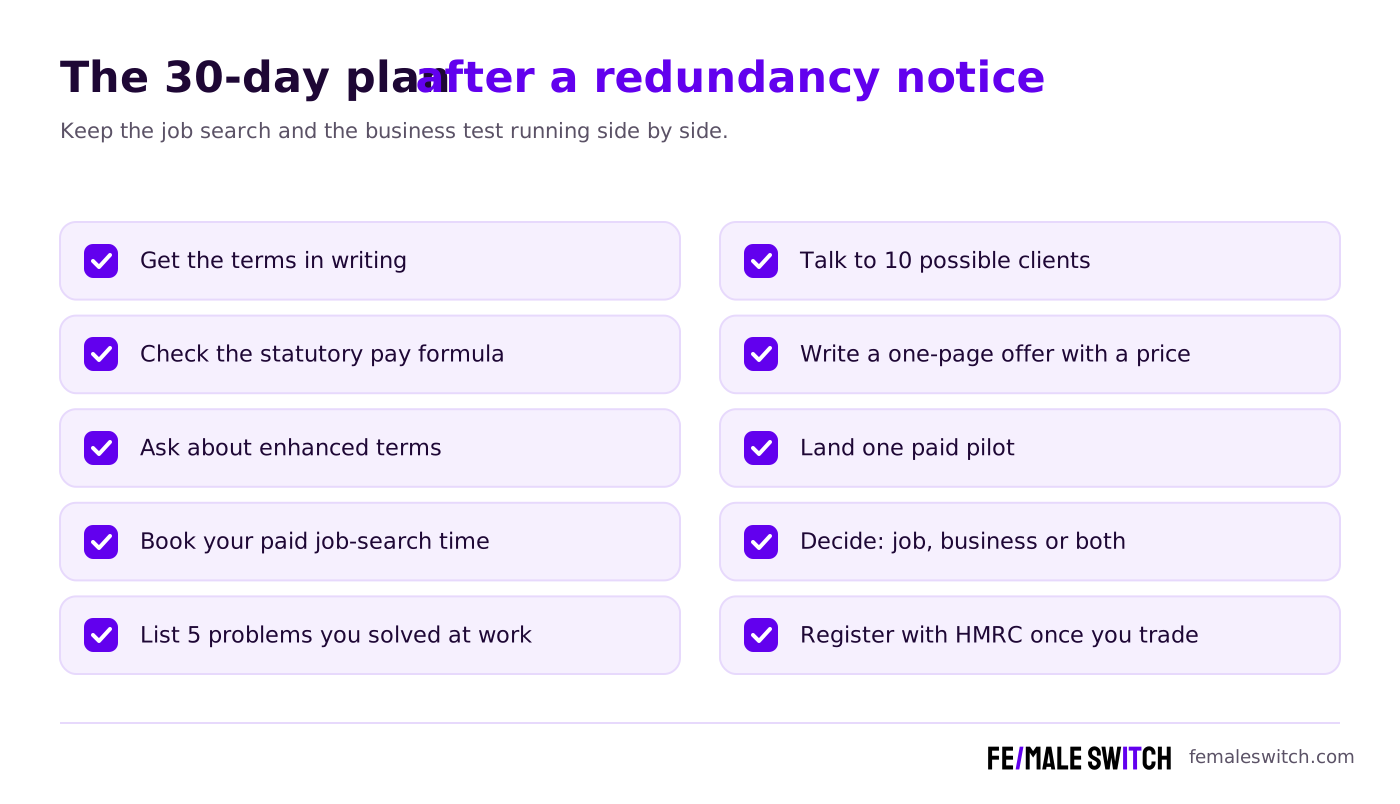
- Days 1 to 3: get everything in writing. Your proposed leaving date, notice, statutory and enhanced pay, holiday pay and any settlement terms. Check the statutory figure yourself with the formula above.
- Week 1: list five problems you solved at work. Write each as a client would describe it: “our month-end reconciliation takes four days”, “our app failed a security review”. These become your offers.
- Week 2: talk to ten possible clients. Former colleagues who left for startups, suppliers you worked with, founders in your LinkedIn network. Ask about their problem, and leave the selling for later. Our LinkedIn strategy for female founders helps here.
- Week 3: write a one-page offer with a price. A fixed scope, a fixed price, a start date. Our pricing strategy guide covers how to set it without underselling a decade of experience.
- Week 4: sell one paid pilot. One paying client tells you more than fifty applications. If nobody pays, you’ve lost nothing and your job search kept running.
How do you set up as a sole trader in the UK?
HMRC wants to hear from you by 5 October after the end of the tax year you started trading in, so register as soon as the first invoice goes out and avoid the scramble. Open a separate bank account for the business from day one, which makes the tax return far easier.
Turn your skills into your first startupThe Fe/male Switch startup game takes you from idea to first paying customers in weekly quests, with an AI co-founder and a community of founders.
👉 Start the game
FAQ: Barclays redundancy and starting your own business
How much redundancy pay will Barclays staff get?
The legal minimum is statutory redundancy pay: after two years’ service, between half a week and one and a half weeks of pay per year depending on your age, with weekly pay capped at £751 and a maximum of £22,530. Your contract may promise enhanced terms, so ask HR in writing.
Is redundancy pay taxed in the UK?
Statutory redundancy pay under £30,000 isn’t taxable, according to gov.uk. Other payments, such as pay in lieu of notice or holiday pay, follow their own rules.
How long is the redundancy consultation at Barclays?
UK law sets minimums: at least 30 days before the first dismissal when 20 to 99 roles go at one site, and at least 45 days for 100 or more. Barclays says its cuts are subject to collective and individual consultation as required.
Can I start a business while I’m still serving my notice?
Check your contract first for clauses on other work and on competing with your employer. Talking to possible clients and testing an offer comes first anyway; start invoicing once you’re free to trade.
Do I need to register with HMRC to go freelance?
You can start trading straight away. Register for Self Assessment if you earn more than £1,000 from self-employment in a tax year, by 5 October after the end of that tax year.
Is there government funding to start a business after redundancy?
The Start Up Loans scheme lends £500 to £25,000 at a fixed 7.5% a year with up to 12 months of free mentoring, for UK businesses trading for less than five years.


