



Poetry is one of the most “human” art forms. People translate feelings, memories, ideas, and experiences into poetry using rhyme, rhythm, and vivid imagery.
Among the most prominent tools is ChatGPT, particularly advanced models such as ChatGPT based on GPT-5.1, which can generate meaningful, expressive, and even rhyming verses.
AI’s role in the creative process of writing poetry has sparked growing interest, prompting entrepreneurs, researchers and creators alike to explore both the reasons behind its effectiveness and the methods by which these technologies craft poetic language.
This explores how AI creates poetry, balancing creativity and computation to produce work that feels both personal and polished, thus providing tools and methods that can also assist startups in building emotional resonance with their audience.
We will now explore the intersection of art and algorithms.
Overview of Artificial Intelligence
Essentially, AI aims to replicate and simulate human intelligence. It learns various patterns from different sets of data and uses these to complete novel tasks.
The domain of AI applications, no longer limited to solving advanced mathematical problems, includes various innovative activities, such as composing music, painting, and writing. Ideal for creative startups.
The capability of AI to compose poetry is an extraordinarily innovative application.
What are the processes that allow AI to develop such intricate and emotional constructs as poetry?
AI systems function on algorithms of machine learning (ML) and natural language processing (NLP). Machine learning provides the requisite tools for an AI system to autonomously refine its operations and learn from its previous analyses.
Natural Language Processing facilitates the articulation of ideas and the understanding of human discourse, enabling the AI system to compose texts, paragraphs, and complete poems of elaborate structure
AI systems are trained on classic and contemporary poetry and prose. AI systems learn the structural and compositional features of a poem, including rhyme, rhythm, and metaphor, and then use that to generate poems.
It is able to imitate the stylized patterns of renowned poets to produce original works.
How AI Works to Create a Rhyming Poem?
AI faces interesting challenges in literature, and creating a rhyming poem is one of them. Here’s how this technology crafts a rhyming poem.
- Training with Data: AI understands the structures, themes, and effective rhyming patterns of poetry by being trained on a large dataset consisting primarily of poems. The dataset needs to be diverse since a variety of poetry styles enable the AI to produce poems in different styles.
- Understanding Rhymes: When a poem needs to rhyme, AI analyzes and determines if the poem’s words have similar ending sounds. It utilizes similar words rhyming techniques and similar databases to find contextual rhymes. This allows the AI to produce words and maintain the poem’s rhythm and rhyme pattern.
- Building Lines: Once the AI has learned the bare necessities that it needs to understand rhyme rules, it may begin to construct lines of poems in different forms. As an example, in case the user searches a poem whose first two lines rhyme with AABB, the AI replaces one rhyming couple with the first two lines of the poem, and others with another rhyming couple with the second and third lines. The AI takes note of the rhythm of the poem to ensure that it is smooth, but it also honors the forced rhyme scheme.
- Creating Significant Text: The widespread myth that it is easy to add rhyming words to a given sentence tends to put a blind man in the middle of the issue that the problem lies in cohering the words and creating meaning. The AI uses the lines, which have been pre-assigned, and the contextuality, emotional component of the poem to rhyme the lines besides using grammatical and syntactic abilities to come up with a single and rational poem. The correlation of the words is not one that is determined by sound only, but it offers a given evoking experience.
- Verse Connection: Hauling one verse onto another, this is where the trouble of poetry betokens its arrival. Every single line is to be falling down the page, illegible, written, and pointed by some universal concept or feeling.
Provide Unique and Fresh Ideas
AI poetry can take a novel approach to the genre. But how can technology generate fresh and unique ideas while avoiding a mechanical and formulaic approach?
Take AI’s ingenuity and data science. After digesting a body of poetry and prose, one comes to appreciate the diverse techniques of poetry before deploying innovation to inspire a diverse mix of patterns and techniques.
A user prompt requesting a “Love poem with Nature Imagery” suggests a synthesis of Wordsworth and Neruda, blending nature and love as a modern theme.
Example:
If you were to input the phrase “the sky was blue” into AI Poem Generator, it might output something like:
“The sky was blue,
Like a big, bright pool.
Clouds floated by,
Soft and woolly, cool.
Birds flew high,
Singing a sweet song.
The blue sky watched,
All day long.”
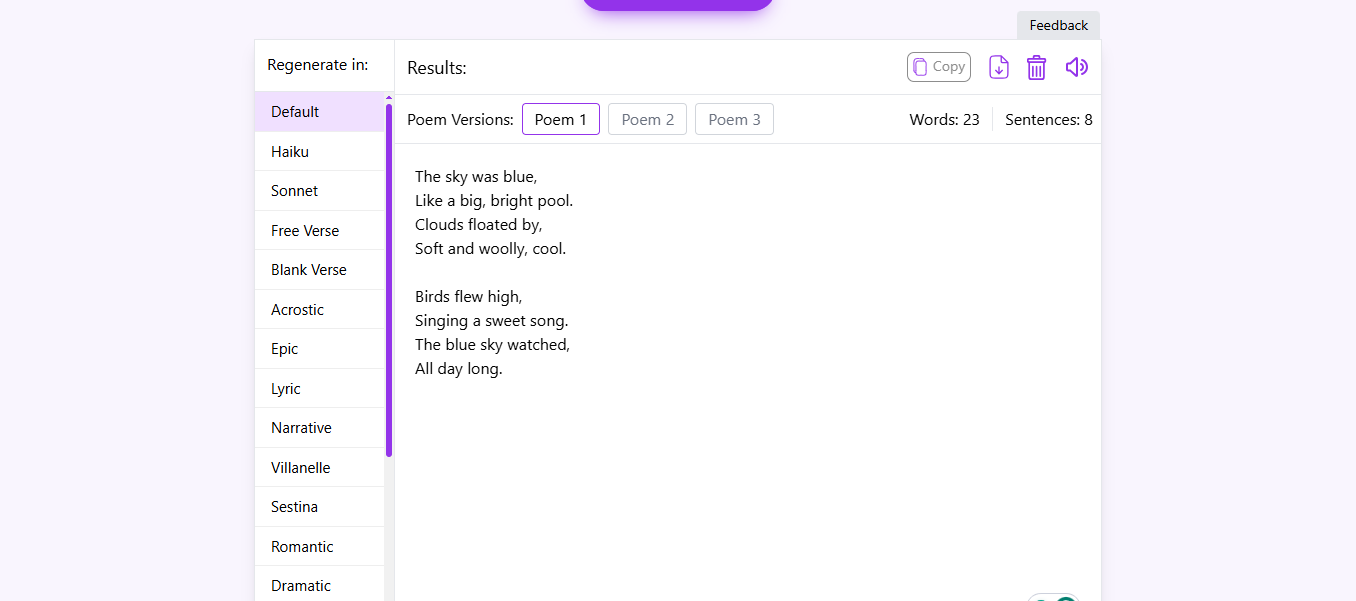
This poetic, yet fresh perspective shows how AI can mix the traditional with the unexpected, creating something new out of familiar concepts.
Generate a Complete Poem Instantly
Among the peculiarities of AI, there is the speed of getting a whole poem with the thought of a prompt. The AI-based poetry tool can compose a poem, entirely rhymed, and in a way that is coherent, within a few seconds.
These instant poetry creations can also be useful to even less sophisticated poetry lovers, particularly in business scenarios where it is necessary to be creative and inspiration is required.
This is the way the process usually goes:
- Step 1: You make a prompt or theme.
- Step 2: AI finds a list of rhyming words on the basis of databases and rhyme-finders.
- Step 3: That system contextualizes such words in a sequence that follows the poetic rules.
- Step 4: You are shown the poem as-is, and can make adjustments to the poem.
As a result of these moves, combined with the time-saving methods that are deployed, customized poetry can be developed within several minutes.
What Types of Poems Can AI Make?
The creation of AI poetry has a broad spectrum of forms. It follows nearly all forms of poetry, both old and new. The following forms of common poetry can be generated with the aid of an AI poem generator:
- Haikus: These are brief 3-line poems, the pattern of which is 5-7-5. They are ideal for brief thought expression.
- Sonnets: The AI can write in classical Shakespearean sonnets, which entail the 14 lines and rhyme schemes of (ABAB CDCD EFEF GG).
- Limericks: These can also be generated by the AI. They are comedic poems consisting of 5 lines and an ABBA design. A poem generator can also create limericks with a theme or keywords that are synthesized using AI.
- Free Verse: These are the poems that do not have fixed rhymes or a metre. The AI is also capable of writing free verse poetry, as well as being more versatile since it evaluates emotions and rich descriptions rather than cadence.
- Acrostic Poems: AI also composes acrostic poems (in which the first letter of each line spells a word or message).
AI can meet the specifications of all the different types of poems and produce a work that perfectly complies with the intended design, the target audience of your startup and, of, course, written in your brand voice.
Conclusion
AI has been progressing in creative fields, and poetry is no exception. AI demonstrates the advanced abilities and artistry of a poetry creation tool as it produces poems that rhyme and meaningfully connect the different verses.
AI can compose verses that meet or surpass human creative capabilities, be it a simple verse or a complex sonnet. As technology advances, AI will likely push creative limits in literature even further. The combination of art and technology is amazing, and AI is making it more accessible than ever.
FAQ on AI poetry for startups
How can AI-created poetry be useful for startups?
AI poetry can inspire fresh, creative ways to communicate a brand’s vision. It leverages unique rhyme schemes, emotional depth, and vivid imagery that startups can use for engaging content marketing or impactful storytelling to resonate with stakeholders.
What makes AI poetry generation relevant to branding?
Startups benefit from authentic storytelling, and AI poetry generation helps craft content that connects emotionally. Using AI-driven poetry allows startups to create taglines, mission statements, or marketing campaigns that are both poetic and memorable.
What role does training data play in AI poetry?
AI uses massive datasets of classic and contemporary poetry to learn patterns like rhythm, rhyme, and structure. This enables it to produce text that feels both human-like and ingenious, allowing startups to experiment with creative content opportunities.
Can AI poetry be customized for specific audiences?
Yes, AI tools can align with specific themes or tones provided in user prompts. This customization allows startups to tailor poetic content for targeted demographics or investor pitches, adding an emotionally resonant layer to communication efforts.
What language styles can AI poetry tools generate?
AI can produce a range of styles, from traditional rhyming patterns to modern free verse. Startups can adapt these forms for everything from creating taglines to presenting compelling narratives in pitch decks.
How startups can use AI poetry for brainstorming?
Startups can input prompts related to their brand values or new product features into AI poetry generators. This unlocks creative synergies by providing unique phrasing, enabling founders to think outside the box during marketing or branding brainstorms.
Could AI poetry be used as a viral content strategy?
Absolutely. Poems have universal appeal and can evoke strong emotional responses. By incorporating themed poetry into social media or email campaigns, startups can create buzz-worthy content that drives interest and engagement.
How does AI ensure coherence in poetry?
AI’s natural language processing capabilities help ensure that the generated poetry flows well and conveys logical meaning. This method makes AI-crafted poetry not only creative but contextually relevant for startup applications.
Is AI poetry only for creative industries?
Not at all. While it certainly benefits creative startups, even fintech or SaaS startups can use AI poetry to create engaging value propositions or humanize technical concepts for broader appeal.
What are the limitations of AI-driven poetry for startups?
While AI can generate imaginative and stylistically diverse poetry, it may lack deep cultural knowledge or unique personal insight. For startups, combining AI poetry with human creativity will yield the most impactful outcomes.


