



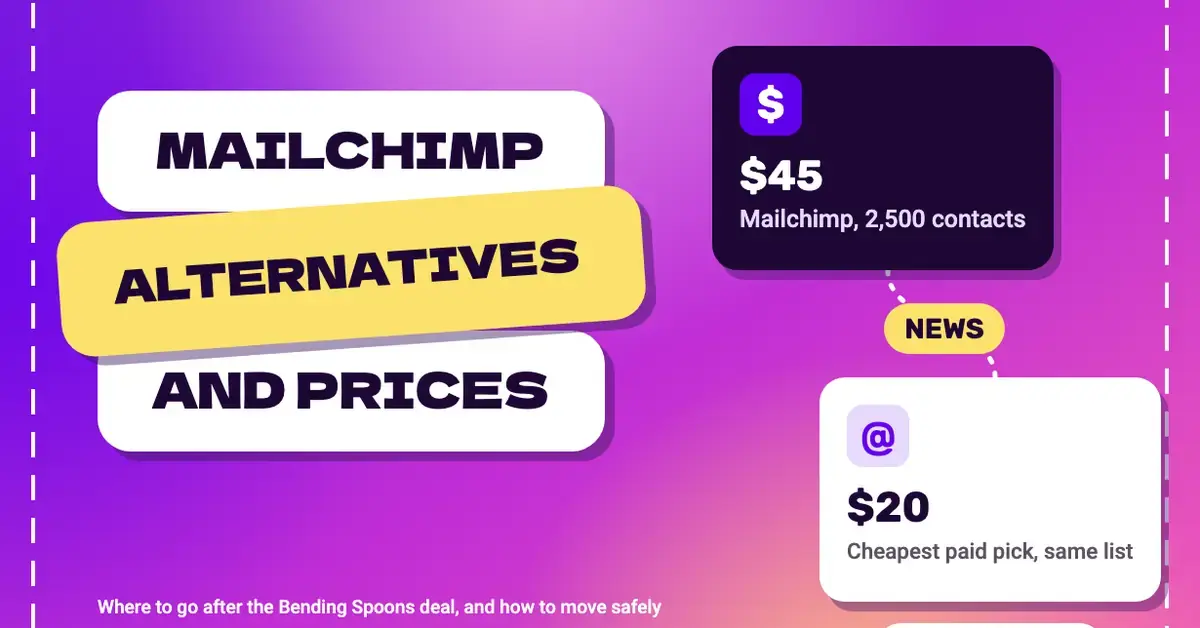
TL;DR: Mailchimp alternatives in November 2026Intuit agreed on 19 November 2026 to sell Mailchimp to Bending Spoons, and the deal is expected to close in early 2027. Nothing changes for your account today. Our advice: export your data this week, then decide when Mailchimp’s prices or terms move. For 2,500 contacts Mailchimp Essentials costs $45 a month; EmailOctopus costs $20, Brevo $25, Sender $27 and MailerLite $33. Kit, beehiiv, EmailOctopus and Sender also have free plans that cover 2,500 subscribers, with limits.
Prices were checked on 20 November 2026 on each official pricing page, in US dollars with monthly billing, without this week’s Black Friday codes.
Should you leave Mailchimp now?
Violetta’s take as a bootstrapper: your email list is the one marketing asset you fully own, so keep a copy on your own computer. Export it now, set a calendar reminder, and decide when Mailchimp announces new prices or terms. Leaving in a hurry costs more than leaving on your own schedule.
One cost check you can do today: Mailchimp counts unsubscribed contacts toward your monthly contact limit, while cleaned contacts don’t count, according to Mailchimp’s help center. If you pay for a big audience, that is the first number to look at.
How much do Mailchimp alternatives cost in November 2026?
Entry paid plans at three list sizes; brackets mark plans that also cap your sends.
Which Mailchimp alternative fits which small business?
MailerLite: the closest swap
Watch out: the free plan covers only 250 active subscribers, and templates, forms, landing pages and automations don’t come across; you rebuild them. Only simple field-based segments transfer.
Brevo: pay for emails, keep big lists
Watch out: the low price at 10,000 contacts buys only 20,000 emails a month, two per contact. Send weekly and you climb to higher tiers fast.
Kit: for creators who sell
Kit, formerly ConvertKit, is led by founder and CEO Nathan Barry. Its free plan covers up to 10,000 subscribers, and its FAQ says there are no sending limits on any plan. Creator costs $39 a month at 1,000 subscribers, with a promotion of $20 a month for the first three months until 1 December. Kit’s importer brings subscribers over with their tags and fields intact.
Watch out: we could not read Kit’s prices at 2,500 or 10,000 subscribers, so check the pricing page with your own number. Kit’s homepage showed our screenshot tool a bot check, so there is no screenshot.
beehiiv: when the newsletter is the business
beehiiv, the New York company led by co-founder and CEO Tyler Denk, raised a $33 million Series B led by NEA in April 2024, according to TechCrunch. The free plan covers up to 2,500 subscribers with unlimited sends. Lite costs $59 a month up to 1,000 subscribers, $79 up to 2,500 and $139 up to 10,000. Its Mailchimp content importer moves past campaigns built with Mailchimp’s New Email Builder.
Watch out: beehiiv is the priciest paid option here, and it is built for publishing. A shop that needs order emails and abandoned-cart flows fits better elsewhere.
Moosend: cheap automation from Constant Contact
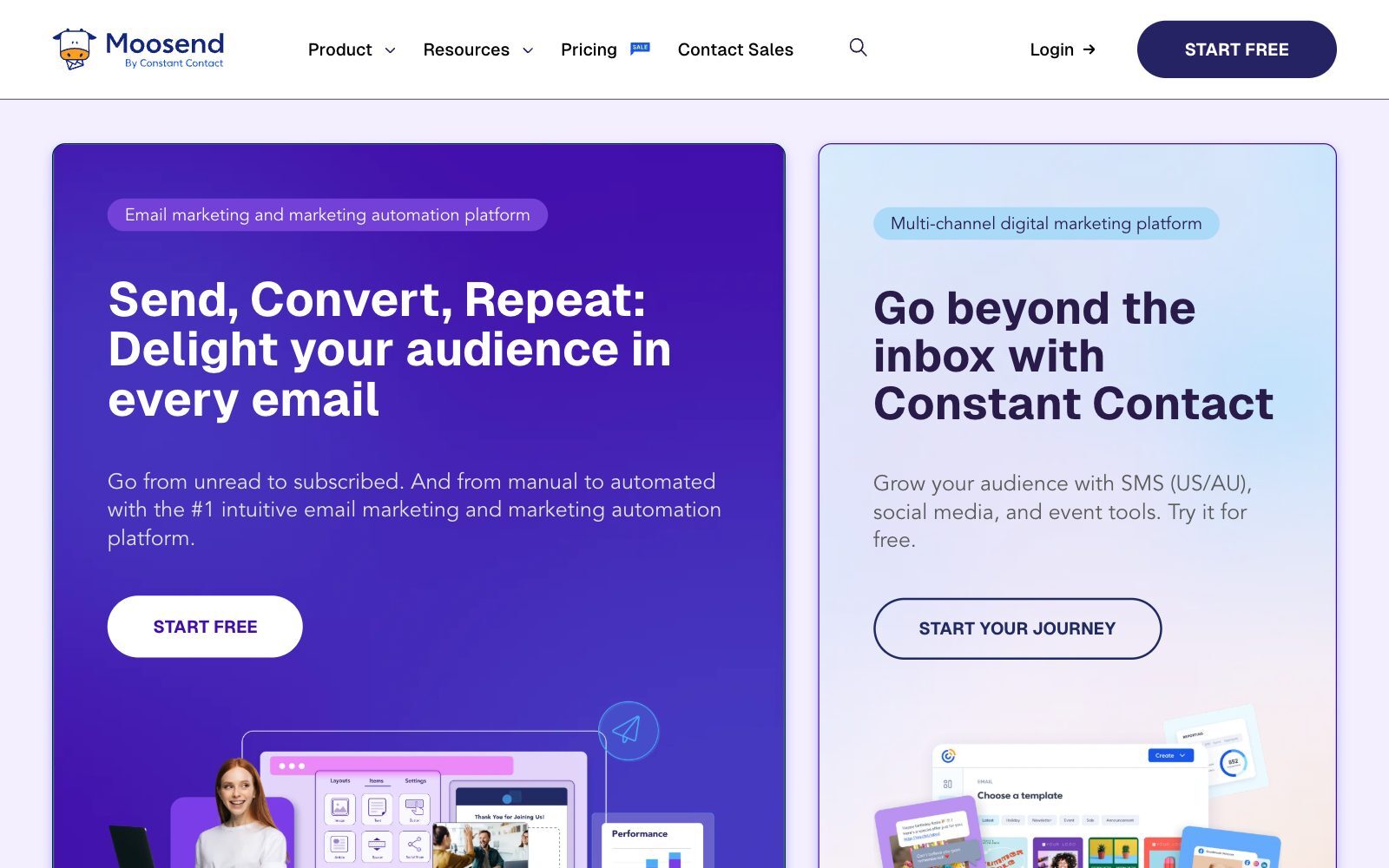
Moosend’s logo reads “By Constant Contact”. Its Pro plan costs $9 a month at 500 contacts, $32 at 3,000 and $88 at 10,000, with unlimited email sends.
Watch out: there is no free plan, only a 30-day trial for up to 1,000 contacts. There is no 2,500 tier either, so a list of 2,500 pays the 3,000 price. Moosend’s Mailchimp import help page returned an error when we opened it, so test the import in the trial.
EmailOctopus: the lowest price
Watch out: EmailOctopus sticks to email, with fewer extras. Templates built in Mailchimp’s new builder can’t be exported into it; only custom HTML can be pasted in.
Sender: a generous free plan for small lists
Sender’s free plan covers 2,500 subscribers and 15,000 emails a month, with Sender branding on your emails. Standard costs $9 a month at 500 subscribers, $27 at 2,500 and $69 at 10,000. Sender advertises “EU-hosted data” and a designated data protection officer. Its migration guide says to set up your sending domain first, because Mailchimp’s DNS records will not work for Sender.
Watch out: the cheapest Black Friday prices on the page require paying for 24 months up front. Compare the monthly price before you lock in two years.

Listmonk: own the whole stack
Watch out: you or a developer handle hosting, updates, backups, bounces and deliverability. The newest release on the site, 7.0.0-beta.2 from 10 November 2026, is a beta.
How do you move from Mailchimp without losing subscribers or consent records?
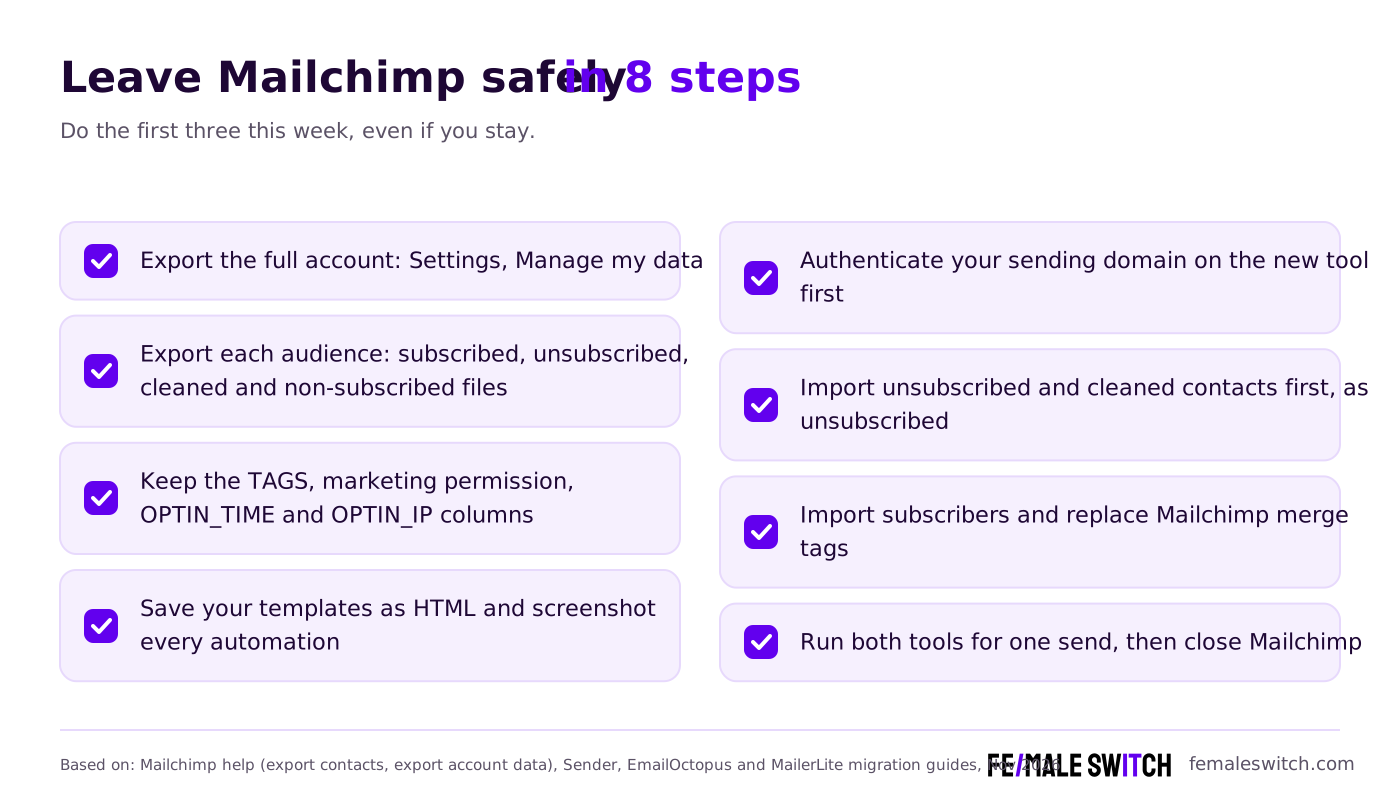
- Back up the whole account. In Mailchimp go to Account, Settings, Manage my data, tick every data type and export. The account export takes up to 24 hours, runs once a day and includes your email templates as HTML files.
- Export each audience and store the ZIP somewhere you control. Only Owners and Admins can export.
- Write down your automations. Screenshot each one with its trigger, delay and email; MailerLite, Kit and beehiiv all say you rebuild automations by hand.
- Set up the new tool’s sending domain (SPF, DKIM and DMARC records) before you import anyone.
- Import unsubscribed and cleaned contacts first, marked as unsubscribed, so the new tool never emails them. EmailOctopus and Sender both give this advice.
- Import your subscribers with tags, consent and opt-in fields. Keep the opt-in IP and time as custom fields.
- Replace merge tags such as *|FNAME|* in your templates with the new tool’s codes.
- Send one test campaign from the new tool, check replies and bounces, then pause Mailchimp. Keep the export files after you close the account.
What this means for you
- Solo founder under 2,500 contacts: a free plan from Sender, EmailOctopus or Kit covers you today. Export from Mailchimp first.
- Small shop or service business: MailerLite is the closest swap; Brevo suits big lists you email a few times a month.
- Creator selling products or courses: Kit, with its 10,000-subscriber free plan.
- Paid newsletter: beehiiv, if the newsletter is the product.
- Tech-savvy team: Listmonk with Amazon SES, if someone owns the server.
Build your first startup with an AI co-founderThe Fe/male Switch startup game takes you from idea to first paying customers in weekly quests, with an AI co-founder and a community of founders.
👉 Start the game
FAQ: Mailchimp alternatives
Will Mailchimp prices go up after the Bending Spoons deal?
Nobody knows yet. Intuit’s 19 November 2026 release says nothing about prices, and the sale is expected to close in early 2027, subject to regulatory approvals.
What is the cheapest Mailchimp alternative for a small business?
At 2,500 contacts, EmailOctopus Pro costs $20 a month with monthly billing, against $45 for Mailchimp Essentials. Sender, EmailOctopus, Kit and beehiiv also have free plans that cover 2,500 subscribers.
Which Mailchimp alternatives store data in the EU?
MailerLite says it stores data in an EU data center, EmailOctopus uses Amazon Web Services in Ireland, and Sender advertises EU-hosted data. Ask any vendor for its data processing agreement.
Will I lose subscribers when I leave Mailchimp?
Only if you skip steps. Export every status, import unsubscribed and cleaned contacts first as unsubscribed, and keep the consent columns.
Can I move my Mailchimp templates and automations?
Templates leave as HTML files in Mailchimp’s account export, and EmailOctopus warns that new-builder designs can’t be moved into it. MailerLite, Kit and beehiiv all say automations are rebuilt by hand, so screenshot them before you go.
Should women founders and solo founders leave Mailchimp now?
Export now and decide later. A free plan elsewhere can cover a list of up to 2,500 today, so test one alongside Mailchimp before any price change forces a rushed move.


