



Key Takeaways
- Social travel apps combine trip tracking, journaling and social sharing into a single travel experience.
- Core features include GPS route tracking, digital travel diaries and interactive travel maps.
- Modern platforms drive engagement through community discovery, collaborative trips and travel storytelling.
- Revenue comes from premium subscriptions, affiliate partnerships and print-on-demand travel books.
- How IdeaUsher can help you build scalable social travel apps with AI features, geospatial infrastructure and secure cloud architecture.
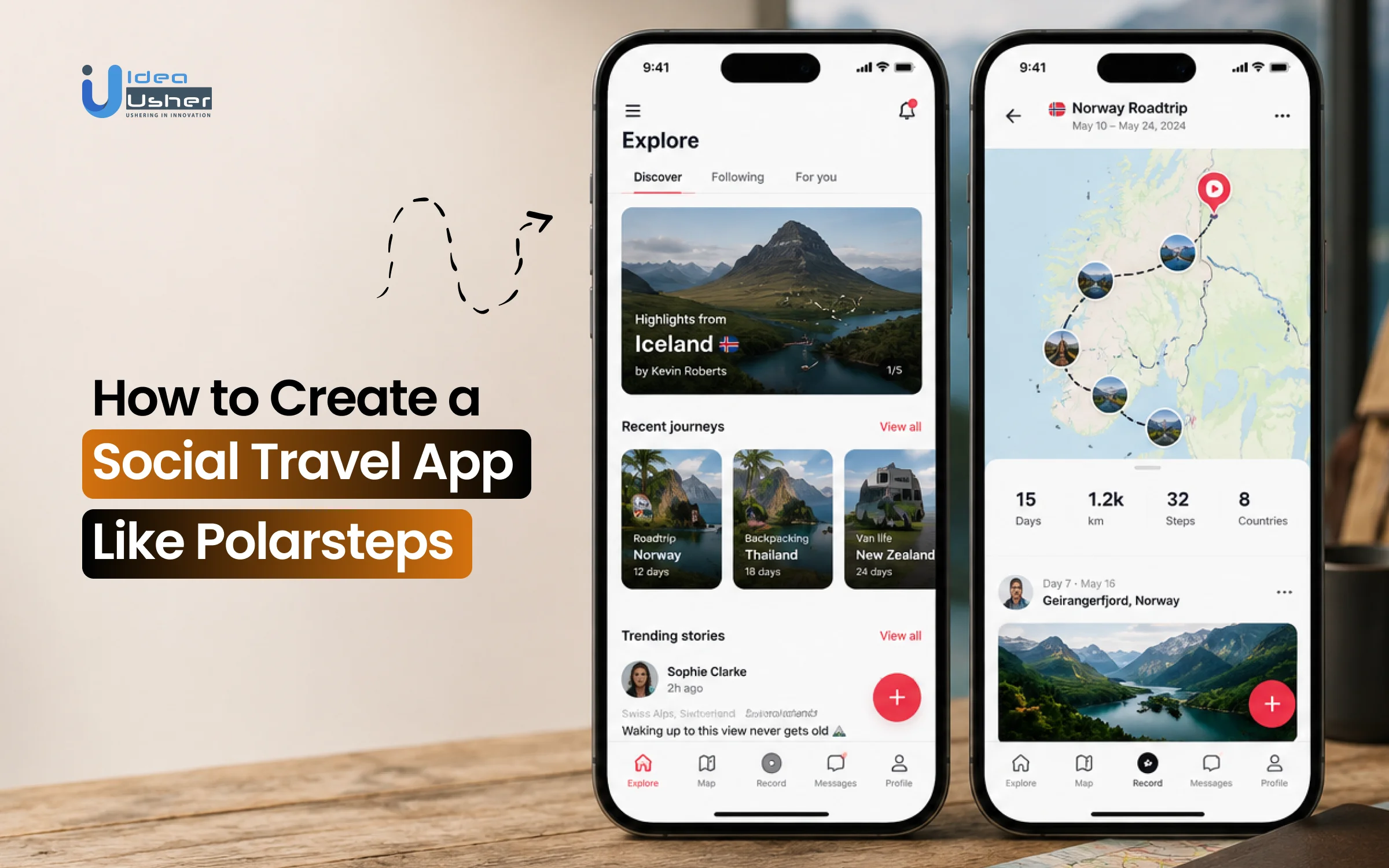
Travel experiences are increasingly being shared in real time, yet most travel platforms still separate trip planning, journey tracking and social sharing into disconnected experiences. That shift is creating new opportunities in social travel app development, where users can document journeys, connect with communities and build lasting travel memories within a single platform.
Traditional travel apps focused primarily on bookings, maps or itinerary management. Modern travelers increasingly expect live route tracking, digital travel journals, social interaction, collaborative trip experiences and location-based storytelling that transform travel from a personal activity into a shareable experience. The value is no longer limited to helping users reach a destination. It is about helping them capture, organize and share the journey itself.
In this blog, we will talk about core features, architecture, development costs, monetization strategies and how IdeaUsher can help with social travel app development like Polarsteps by combining travel tracking, journaling and social engagement into one ecosystem.
Why Social Travel Platforms Are Growing Rapidly
The global travel planner app market is scaling at an explosive pace, projected to grow from $544.1 billion to over $1.45 trillion, maintaining a steady 11.9% Compound Annual Growth Rate (CAGR). Concurrently, the dedicated travel application sector is expanding independently at a rapid 15.6% CAGR.
The travel industry is shifting from fragmented booking tools to unified, socially driven mobile platforms. Today, travel apps influence over 70% of travel decisions, while 55% of travelers share experiences online and 53% discover future destinations through social content, accelerating demand for integrated travel and social engagement ecosystems.
A. The Shift From Travel Planning To Travel Storytelling
Traditional travel planning, once dependent on text forums and spreadsheets, is losing ground to efficient mobile-first solutions. Consequently, mobile apps now hold a 71% market share among online travel planning channels.
Modern travelers are facing platform fatigue with traditional star-rated reviews. Research indicates that 82% of Millennials and Gen Z are significantly more likely to select destinations or activities if they offer a compelling narrative or a good story.
By replacing static text listings with highly interactive, geo-tagged micro-vlogs, map routes, and visual media, social travel applications transform the research phase from a transactional chore into an engaging, narrative-driven discovery loop.
B. Why Travelers Want Living Digital Travel Diaries
The consumer demand for geographic archiving is rising as traditional storage lacks clean trip organization. Consequently, the travel planner market is projected to grow from $3.42 billion to $10 billion, with itinerary planning and digital mapping alone reaching a $3.00 billion valuation.

Modern explorers are moving away from chaotic, unorganized cloud photo dumps. Instead, they are opting for structured digital diaries that provide immediate, tangible utility:
- 76% of global travelers believe that the unique skills, cultural lore, and personal memories gained during a journey outlast any material souvenir.
- 87% of travelers prioritize leaving open windows within their itineraries for spontaneous local discoveries.
Digital travel diaries satisfy this demand by auto-tagging media with background GPS coordinates. This secures spontaneous discoveries and hidden spots on an interactive timeline, serving as a private memory archive and a shareable travel guide.
C. Market Trends Driving Social Travel App Adoption
Several macroeconomic and generational data points are accelerating the global adoption of social travel platforms:
- The Travel-First Budget Shift: Travel is now a top financial priority. Data indicates 40% of global travelers are increasing their budgets, and 74% of Millennials and Gen Z view travel as an essential, non-negotiable expense.
- The Push for Local and Experiential Discovery: Modern travelers prioritize authentic localization over mass tourism. Over 60% of global consumers buy local food while traveling, and 75% of younger demographics rely on social networks to discover regional dining and experiences.
- The Urgency for Hyper-Personalization: Travelers now favor personalized, peer-driven recommendations over generic itineraries. Currently, 68% of mobile users seek custom suggestions tailored to their specific travel styles.

What Is Polarsteps and Why Has It Scaled Globally?
Polarsteps is an all-in-one travel app that automatically tracks your route, logs your photos, and maps your journeys into a digital travel journal. It operates as a social utility and memory keeper, allowing users to share their live vacation progress with friends and family back home without manual check-ins.
The Amsterdam-based travel scaleup Polarsteps has grown to 18+ million users by rejecting the traditional attention-driven ad-tech model, instead scaling through product-led viral growth centered on private travel memories and authentic user experiences.
A. The Plan–Track–Relive Travel Experience
Polarsteps manages the entire travel lifecycle by elegantly solving user pain points across three distinct phases of a journey:
1. Plan: Visual Itinerary Building: Pre-Trip
Before the journey begins, users build interactive, visual itineraries. Instead of generic AI recommendations, the app helps travelers map out transport legs and plot routes while sourcing tips directly from a curated community and travel editors.
2. Track: Ambient Location Logging: During Trip
While on the move, the app utilizes pioneering, battery-efficient ambient location technology. It automatically tracks the user’s route and plots it on a dynamic 3D digital world map working seamlessly offline and without draining the device’s battery. Travelers simply pin photos and thoughts to specific geographical coordinates along the way.
3. Relive: Instant Memory Crystallization: Post-Trip
Once the trip ends, the digital diary is fully formed. Users can instantly review their statistics (total countries visited, distance covered, duration). More importantly, the app automatically compiles this data into a beautifully formatted, physical, hardcover “Travel Book” that can be printed with a single tap.
B. The Product Strategy Behind Polarsteps’ Growth
Polarsteps’ rise to the top of Europe’s travel-tech market isn’t the result of aggressive paid acquisition or multi-million dollar marketing blitzes. Their head of growth highlights a hyper-focused, product-led strategy that builds compounding value:
- Privacy-First Product Loops: Unlike traditional social media platforms that force public broadcasting, Polarsteps focuses on intimate, closed-loop sharing. Users invite small circles of close family and friends to follow their real-time map. This high-trust environment creates a low barrier to sharing, driving massive organic retention.
- The Travel Book Ecosystem: Polarsteps treats monetization as a value-added extension rather than an interruption. By partnering with global print-on-demand APIs (like Peecho), they allow users to convert their digital travel maps into high-quality physical photo albums. This single feature generates millions in revenue while perfectly aligning the business model with user desire, completely eliminating the need for data-selling or distracting ads.
- Asymmetric Network Effects: Every time a traveler updates their route, an automated, visually striking notification is sent to their followers. These followers intrigued by the beautiful, interactive mapping interface frequently convert into active tracking users during their own next vacations.
C. What Entrepreneurs Should Replicate In Their Own Platform
For founders and product builders looking to build the next generation of social travel or consumer applications, Polarsteps offers a masterclass in clean execution:
| Core Strategy | The Polarsteps Execution | Entrepreneurial Lesson |
| Monetization Model | Replaced intrusive ads with tangible, 1-click print-on-demand Travel Books. | Monetize through physical or premium travel books that actively reinforce the core user experience, keeping your user as the customer, not the product. |
| Frictionless Utility | Ambient tracking works automatically in the background, fully offline. | Minimize user friction during high-activity moments. If an app requires constant manual input while a user is living their life, retention will plummet. |
| Value Personalization | Models AI around individual transport choices, pacing, and past habits. | Avoid generic content generation. Use data and personalization to enhance the user’s specific journey, rather than giving them statistical averages. |
The Big Takeaway: Sustainable, hyper-scale growth happens when product quality naturally handles user acquisition. When you create a highly visual utility that people love to share with their inner circles, your users effortlessly become your primary marketing channel.
How A Social Travel App Like Polarsteps Works
Behind Polarsteps’ seamless user experience lies a complex system of background location threads, geospatial data pipelines, and offline-first client architectures. The platform shifts effort away from the traveler, turning passive background data into an interactive, visual journey.
1. Trip Creation & Destination Planning
Travelers use the app as a digital canvas in their pre-trip phase to define trip profiles with start dates, destinations, and durations. The interface enables itinerary sketching by pinning check-in hubs or connecting transport legs.
This phase builds the underlying structural data object on the device. It sets specific geofence perimeters and notifies selected friends or family that an active journey is about to begin, establishing the structural framework for all future location data points.
2. Route Tracking During The Journey
Once the traveler departs, the app uses low-energy ambient tracking. To conserve battery, it avoids continuous GPS pings, instead using cell tower handshakes, Wi-Fi shifts, and accelerometers to wake native background location managers.
The app activates high-precision GPS only when significant location changes occur to log “breadcrumb” coordinates. These points are sent to the server, where geospatial algorithms refine the data, eliminating jumps to snap the route accurately to roads or flight paths on a 3D globe.
3. Offline Tracking And Travel Data Sync
Travel often exceeds cell coverage, so the platform utilizes an offline-first data model. In remote areas, a local SQLite database logs GPS breadcrumbs and caches high-resolution media and journals directly on the device.

The application client constantly monitors network availability using low-level operating system hooks. The second a reliable cellular or Wi-Fi handshake is detected, a background synchronization task opens a secure channel to the server, chunking and pushing the accumulated offline logs to the cloud without interrupting the user.
4. Real-Time Sharing And Community Engagement
The platform transforms raw location telemetry into a social experience through a geographic content delivery pipeline. When a traveler uploads a photo or writes a journal entry, the app reads the media’s metadata to automatically map it to the corresponding GPS checkpoint on their public or follower-only timeline.
Followers get automated updates on a traveler’s journey. Using an interactive map instead of a standard feed, friends can track the route, comment on checkpoints, and view media linked to specific locations.
5. Post-Trip Memory Preservation And Reliving
The journey concludes by transforming from an active tracker into a digital keepsake. The app processes trip data to create a shareable, chronological timeline of every stop, transport mode, and journal entry.
Concurrently, the backend updates the traveler’s global passport profile by recalculating distance and exploration metrics. This compiled data integrates with an automated layout engine, enabling users to instantly convert their digital routes and stories into a physical, hardbound travel book with one tap.
Core Features of Polarsteps-Like Social Travel App
Building a successful social travel platform requires finding the sweet spot between utility and engagement. The app must function as a reliable utility while the user is traveling, and a beautiful storyteller when they want to share. To capture this balance and scale effectively, a next-generation travel platform needs a highly specific set of core features.

1. AI Trip Planner & Itinerary Builder
Modern travel platforms require intuitive, AI-powered itinerary engines to convert user interests and parameters such as destination, duration, pacing preference (slow travel vs. fast-packed), and personal interests into actionable, customized day-by-day roadmaps.
Instead of delivering generic tourist traps, the engine cross-references past community data and local travel guides to suggest optimized routes, transport options, and hidden gems. Crucially, this itinerary remains highly flexible, allowing users to manually drag, drop, and edit steps on a visual timeline.
2. Battery-Efficient GPS Intelligence Route Tracking
The defining technical backbone of a premier tracking app is its ability to log a user’s physical journey automatically without killing their smartphone battery. If a travel app drains more than 5% of a battery per day, users will delete it.
To achieve this, use smart location clusters instead of continuous GPS pings. The app should utilize cell tower triangulation, Wi-Fi detection, and accelerometers to identify movement. It activates high-precision GPS only for significant shifts, ensuring smooth path plotting while maintaining daily battery usage under 4%.
3. Offline Travel Tracking & Data Sync
Real adventures frequently happen off the grid whether trekking through the Himalayas or cruising open waters. The platform must be architected with an offline-first local database.
When a user has no signal, the app continues to map coordinates and allows them to write stories and attach photos locally. The moment the device detects a stable Wi-Fi network or cellular connection, a background worker quietly syncs the queued data to the cloud without interrupting the user.
4. Interactive 3D Travel Maps & Timelines
The visual centerpiece of the user experience is the digital world map. As a traveler progresses, their path should unfold as a clean, interactive vector line cutting across an elegant 3D globe.
Users can use pinch-to-zoom to view precise daily stops on detailed terrain maps to view global perspective, complemented by a synced vertical, chronological timeline. This integration forms a visual narrative, anchoring photos, icons, and journals to specific locations.
5. Collaborative Travel Buddies & Shared Trips
Travel is frequently a shared experience, meaning the app cannot exist in silos. The “Travel Buddies” feature allows multiple users to co-author a single trip. When linked, the app intelligently stitches together the group’s routes and compiles photos and stories into a unified master timeline. To keep things clean, the system deduplicates overlapping background GPS tracks while allowing individual attribution for photos and text contributions.
6. Travel Journaling With Photo & Stories
A digital travel diary needs to feel rich and tactile. The journaling module must allow users to effortlessly pair high-definition media with text. Each entry, or “Step,” acts as a micro-blog post. Travelers can log their thoughts, embed video clips, and attach multiple photos. To minimize effort on the road, the app reads the metadata of selected photos to automatically suggest the correct timestamp and location for the journal entry.
7. Map-Based Social Feeds & Activity Sharing
To drive community engagement and app open rates, the platform needs a specialized social feed. Unlike traditional social feeds that prioritize generic vertical scrolling, a travel social feed is anchored by geography. Followers open the app to see a live-updating map showing exactly where their friends are in the world.
8. Privacy Controls & Audience Permissions
Because travel maps reveal exact real-time locations and patterns, institutional-grade privacy controls are a non-negotiable requirement. The platform must offer explicit, granular permission tiers for every single trip:
- Public (Everyone): Viewable by the entire community; indexed for global exploration and search.
- Followers Only: Restricted to approved friends and family, creating a safe space for real-time tracking.
- Only Me (Private): Completely locked down, serving as a personal, encrypted digital vault for memories.
The app should also feature a “delayed publishing” option, allowing users to log their trip live but hold social updates until they safely depart a specific location.
9. Travel Statistics & Country Tracking
Gamification is a massive driver of user retention. The platform should automatically calculate and update a personal “Passport Dashboard” as data logs. Travelers love watching their stats stack up:
- Total footprint: Percentage of the world explored.
- Count Trackers: Total number of unique countries, states, and major cities visited.
- Journey Metrics: Total distance covered (miles/kilometers) and a breakdown of transport modes used (e.g., 60% train, 30% plane, 10% foot).
10. Print-on-Demand Travel Book Model
The ecosystem’s premier feature and revenue driver is a frictionless, print-on-demand e-commerce integration. By utilizing global print APIs like Peecho, users can instantly transform digital maps, statistics, photos, and journals into premium hardcover books with one tap.
Automated software manages layout and pagination, converting digital timelines into physical heirlooms. This enables an ad-free model by replacing data-selling with physical, hardcover books that users value.
How To Build A Social Travel App Like Polarsteps
Transforming a social travel concept into a scalable, high-performance application requires a careful blend of low-level device optimization, cloud infrastructure, and user-centric growth loops. Below is the end-to-end engineering and strategic roadmap to take your platform from validation to global scale.

1. Market Research & Product Validation
Before writing a single line of code, you must identify your specific wedge into the travel market. While Polarsteps dominates broad consumer leisure travel, opportunities exist in targeting specific underserved verticals: extreme adventure backpackers, van-life communities, digital nomads, or luxury slow-travelers.
Validate demand by launching targeted landing pages highlighting your unique value proposition, such as tools for specific niches like off-grid overlanders. Analyze user acquisition costs against sign-ups to find a market gap where travelers seek better ways to document their journeys.
2. UX/UI Design & Journey Mapping
The user experience must balance two conflicting states: high activity (when the user is traveling and wants minimal screen time) and deep reflection (when they are home and want to consume content).
Map out the user journey across three strict operational views:
- The Canvas (Map View): An immersive, vector-based map using tools like Mapbox or MapLibre GL. It should feel smooth, responsive, and uncluttered.
- The Ledger (Timeline View): A chronological, vertical feed displaying media, notes, and transport checkpoints side-by-side with the map.
- The Dashboard (Passport View): A highly shareable, gamified personal profile showing global statistics, flags collected, and miles traversed.
3. MVP Development & Core Features
To launch fast and test market fit, your Minimum Viable Product (MVP) should focus on doing three things flawlessly: accurate route plotting, rich media journaling, and clean timeline generation.
Build using cross-platform frameworks like Flutter or React Native to hit iOS and Android simultaneously with a single codebase. Keep the core data architecture lightweight; use local state management to handle media pointers while rendering routes natively using underlying platform map views.
4. GPS Tracking & Location Intelligence Setup
The core technical challenge is tracking a user’s route without draining their device’s battery. Continuous high-accuracy GPS pings will kill a phone battery in hours.
To achieve a target battery consumption of under 5% per day, implement an intelligent location lifecycle using native location APIs (CoreLocation for iOS, Google Play Services Location API for Android):

Process raw coordinates on the backend (Node.js, Go, or Python) using PostgreSQL with PostGIS. Apply a line-simplification algorithm like Douglas-Peucker to convert messy GPS data into smooth lines for the frontend map.
5. Social Networking & Content Infrastructure
To support millions of global users viewing and uploading media, your backend needs an optimized, decoupled content delivery pipeline. Utilize GraphQL or RESTful APIs backed by a distributed database layer.

Implement a robust follow/block relational schema to handle real-time privacy state changes instantly, ensuring hidden or follower-locked trips never leak across global exploration search parameters.
6. AI-Powered Travel Planning Integration
A modern platform shouldn’t just record the past but it should simplify the future. Integrate an orchestration layer (like LangChain) connecting your database to Large Language Models (LLMs) via APIs.
Our AI developers develop an agent to scan community data, top itineraries, and real-time APIs like Yelp or TripAdvisor. By processing user prompts with historical routing, the model generates a structured JSON file featuring geo-pinned hotels, restaurants, and optimized transport routes that integrate directly with the user’s trip map.
7. Offline Functionality & Data Synchronization
Your application must treat internet connectivity as a luxury, not a given. Architect the mobile client with an offline-first local database like Realm or SQLite.
If connectivity is lost, save media and location data locally. Use background workers like WorkManager (Android) or BGAppRefreshTask (iOS) to monitor status. Upon reconnection, upload local changes as unified payloads using CRDTs to ensure data integrity.
8. Quality Assurance & Security Testing
Location-based apps carry strict liability; bugs can result in lost user data or compromised physical safety. Establish a rigid QA framework:
- Location Spoofing Simulation: Use automated testing tools to simulate fast-moving travel profiles (e.g., traveling at 500 mph on a commercial flight vs. 3 mph on a hike) to verify your location logic clusters data cleanly under different speeds.
- Penetration and Privacy Audits: Ensure absolute isolation between public, follower-only, and private data endpoints. Mask precise user coordinates on public profiles by slightly blurring real-time points within a 500-meter radius until the journey concludes.
- Battery Profiling: Conduct physical hardware device testing across multiple generations of devices to guarantee background location threads stay tightly within memory boundaries without inducing processing overhead.
9. Deployment, Scaling & Growth Optimization
Deploy your application backend on containerized infrastructure (Docker with Kubernetes) managed via cloud providers like AWS or Google Cloud. This allows your system to auto-scale horizontally when travel activity spikes during peak global vacation seasons (e.g., June–August).
Post-launch, scale globally by monitoring Day-30 retention and the viral K-factor the number of new users generated by each existing user). Leverage natural viral loops by optimizing invite screens and email alerts for travel updates. Focus on converting web viewers into active mobile users as a cost-effective growth strategy.
Cost to Build a Social Travel App like Polarsteps
The social travel app development like Polarsteps involves costs across mobile development, GPS tracking, route visualization, social networking features, cloud infrastructure, and third-party integrations. The below cost estimate breaks down the key development components, helping you understand the investment required to launch a scalable and feature-rich social travel platform.
A. Social Travel App Cost Estimation Framework
The social travel app development costs are broken down into MVP (Minimum Viable Product) pricing, focusing on essential, cross-platform core features to test the market versus Enterprise-grade pricing, which accounts for deep native optimizations, custom AI models, custom geospatial infrastructure, and planetary-scale security layers.
| Development Phase | Scope & Key Technical Drivers | Estimated Cost |
| Market Research & Validation | User persona definition, landing page validation loops, UX discovery workshops, and click-through test tracking. | $5,000 – $15,000 |
| UX/UI Journey Mapping | Responsive vector map interfaces, dual-state timeline interactions, gamified profile dashboards, and end-to-end interactive prototyping. | $8,000 – $25,000 |
| MVP Core Features Development | Cross-platform build (Flutter/React Native), core itinerary planners, basic chronological media timelines, and light database schemas. | $35,000 – $75,000 |
| GPS Tracking & Geospatial Setup | Low-power ambient location lifecycle handlers, native background wake-locks, server-side Douglas-Peucker line smoothing, and PostGIS database clusters. | $15,000 – $45,000 |
| Social & Content Infrastructure | Decoupled asset pipelines, relational access-control layers for audience privacy, multi-tenant global social feeds, and microservice architectures. | $20,000 – $55,000 |
| AI-Powered Travel Integration | RAG orchestration engines, LLM fine-tuning for custom destination routing, and structured JSON parsing for 1-click timeline generation. | $22,000 – $60,000 |
| Offline-First Functionality | Local SQLite/Realm architectural implementations, automated network sync workers, payload chunking, and CRDT conflict resolution logic. | $15,000 – $40,000 |
| QA Testing & Security | Automated location-spoofing tests, cross-device battery profiling, penetration auditing, and geographical user coordinate masking. | $10,000 – $30,000 |
| Deployment & Optimization | CI/CD native release configurations, containerized infrastructure (Docker/Kubernetes), automated scale setups, and web-viewer viral optimization loops. | $10,000 – $35,000 |
| Total Estimated Project Cost | From a focused initial launch to a fully customized global enterprise platform. | $70,000 – $360,000+ |
Note: The social travel app development costs are estimates and may vary based on custom logic, mapping API usage, and storage requirements. Partnering with IdeaUsher’s 250+ tech experts ensures scalable architecture, optimized battery performance, and stronger long-term profitability.
B. Social Travel App Cost Estimation by Platform Tier
The cost of a social travel app development depends on its feature complexity, scalability, and social engagement capabilities. The table below outlines estimated development costs across different platform tiers, from an MVP to a full-scale social travel platform.
| Platform Tier | Included Features | Total Estimated Cost |
| MVP (Minimum Viable Product) | Manual Journey Logging, Basic GPS Tracking, Basic Itinerary Builder, 2D Map View, Friend Feed, Privacy Controls | $70,000 – $125,000 |
| Mid-Scale Platform | Battery-Optimized Location Tracking, 3D Globe View, Timeline Ledger, AI Itinerary Generation, Audience Permissions, Delayed Publishing, Background Sync, Travel Stats Dashboard | $140,000 – $205,000 |
| Enterprise Platform | Collaborative Trips, Print-on-Demand Travel Books, Automated Layout Engine, Coordinate Privacy Controls, AI Destination Recommendations, Multimedia Social Feed | $220,000 – $360,000+ |
C. Factors Affecting Social Travel App Development Cost
The social travel app development cost depends heavily on platform choice, API integrations, data architecture, and geographic engineering rates. Proper management of these critical variables ensures efficient capital allocation.
- Geographic Engineering Rates: Location is the primary cost variable. North American engineers average $120–$160+/hour, Western European talent $70–$110/hour, and in India the pre-vetted devs are $25–$50/hour.
- Background GPS Engineering Architecture: Standard plugins drain batteries; a custom low-power system (<5% daily consumption) requires native programming costing $15,000–$45,000 to optimize.
- Third-Party API and Map Loads: Infrastructure like Mapbox costs $4–$5 per 1,000 loads post-free tier, potentially scaling monthly costs to $2,000–$10,000 as users grow.
- Cloud Infrastructure and Media Storage: High-definition storage for print-ready media via AWS S3 and CDNs can scale from $500 to over $5,000 monthly based on data volume.
- AI Integration and LLM Processing Fees: Specialized RAG and vector database development costs $12,000–$40,000, plus ongoing token-based variable processing fees.
Challenges In Building A Travel Tracking Platform
The social travel app development requires overcoming complex engineering hurdles at the intersection of device hardware and cloud architecture. Balancing real-time location accuracy with hardware resource limits is essential to creating a reliable, seamless user experience.

1. Battery-Efficient GPS Tracking
Challenge: Continuous high-accuracy GPS pings quickly exhaust smartphone batteries, forcing users to delete resource-heavy travel apps within hours of installation.
Solution: Our developers implement native location managers that rely on low-power cell tower handshakes, waking up high-precision GPS threads only when accelerometer data detects sustained physical movement.
2. Managing Offline User Experiences
Challenge: Travelers frequently lose cellular signals in remote areas, causing unoptimized apps to lose tracking paths and drop media uploads entirely.
Solution: We architect the client with an offline-first local database using Realm, caching all GPS points and high-res media on-device until background synchronization workers detect a stable Wi-Fi connection.
3. Privacy And Location Data Protection
Challenge: Logging real-time coordinates exposes sensitive user habits, creating high compliance liabilities under global data frameworks like GDPR and CCPA.
Solution: We deploy end-to-end transport layer security and write custom privacy masking scripts that automatically blur public live coordinates within a fixed radius until the traveler safely leaves the area.
4. Scaling Social Content Infrastructure
Challenge: Peak summer vacation seasons cause massive user spikes that crash monolithic backends and inflate monthly database hosting and API tile costs.
Solution: Our engineers scale your platform using containerized microservices combined with server-side spatial line-simplification, reducing data payloads by ninety-five percent before serving them to global users.
Security & Compliance Requirements For AI Travel Apps
Data handling moves into a much stricter compliance landscape when dealing with real-time GPS tracking and live user coordinates. Because location history is legally classified as Highly Sensitive Personal Data, consumer and enterprise applications rely on specific compliance frameworks to prove their infrastructure is secure. The standard and regulations governing how real-time GPS tracking data is stored and handled break down as follows:
1. SOC 2 Type II (The Security Standard)
For any cloud application capturing live telemetry, SOC 2 Type II (System and Organization Controls) certification is the gold standard.
While SOC 2 Type I simply checks if you have a security policy on paper at a single point in time, Type II evaluates how well your servers actually protect data over a continuous period (typically 3 to 12 months). If your app stores GPS routes, auditors checking your SOC 2 compliance will verify:
- Data at Rest Encryption: All raw latitude/longitude points stored in spatial databases (like PostgreSQL/PostGIS) must be encrypted using AES-256 bit protocols.
- Data in Transit Encryption: Communication between the traveler’s mobile device and the server must use high-grade Transport Layer Security (TLS 1.3) to prevent intercepting live location streams.
- Role-Based Access Control (RBAC): Your internal development or support team cannot view individual user location histories without strict, audited authorization log entries.
2. GDPR & CCPA (The Privacy Regulations)
Because a person’s location data can easily pinpoint where they live, work, and sleep, privacy frameworks like GDPR (Europe) and CCPA (California) impose heavy operational restrictions on travel trackers:
- Explicit Background Consent: Operating systems (iOS and Android) enforce this at the device level, but your database must log a clear, explicit timestamp of exactly when the user consented to background tracking.
- The Right to Be Forgotten: If a user deletes a trip or their entire account, your backend architecture must completely purge all associated GPS coordinates, server caches, and backup storage files within a strict legal window (typically up to 30 days).
How Engineering Team Handles This Compliance
During your social travel app development, we don’t reinvent the wheel or build compliance tools from scratch. Instead, our developers fast-track your path to audit-readiness by baking security directly into the core infrastructure design from day one:
- Compliant Cloud Infrastructure: We deploy backend microservices on AWS or Google Cloud, leveraging environments with SOC 2 Type II, ISO 27001, and PCI-DSS certifications to inherit enterprise-grade security controls.
- End-to-End Data Encryption: All location data is protected with AES-256 encryption at rest and TLS 1.3 in transit, securing live tracking streams between user devices and servers.
- Automated GDPR & CCPA Compliance: We build automated data lifecycle workflows that permanently remove GPS data, caches, and backups when users invoke their Right to Be Forgotten, ensuring regulatory compliance.
- Location Privacy Protection: Our frontend and backend engineers implement geographic data fuzzing that masks live user locations by up to a customizable 500-meter radius, protecting traveler privacy until a trip is completed or shared.
The Technical Execution: Meeting SOC 2 and GDPR standards for geospatial storage requires expert cloud architecture. Partnering with IdeaUsher and its 250+ specialists ensures secure database access, encryption, and multi-tenant rights from the start. This protects user data, reduces liability, and prepares your platform for enterprise compliance audits.
Polarsteps Clone Vs Custom Travel Platform Development
Entering the social travel market requires balancing immediate social travel app development launch costs against long-term operational efficiency. While an off-the-shelf “Polarsteps clone” script offers an attractive low-cost entry point, a data-driven look at performance bottlenecks, unit economics, and infrastructure scalability reveals why template solutions often fail to survive past early user acquisition phases.
A. Limitations Of Clone-Based Solutions
Clone scripts are pre-packaged code templates designed to replicate surface-level user interfaces. However, they lack the sophisticated background optimization required for continuous location monitoring, leading to immediate performance penalties:
- Excessive Battery Drain: Standard clone templates rely on continuous high-accuracy GPS polling, consuming 18–25% of daily battery capacity. Utility apps exceeding 8% daily battery usage see a 74% uninstall rate within 72 hours.
- Geospatial Performance Bottlenecks: Clone scripts often store location data in flat relational tables. Trips with 5,000+ coordinate points can reduce map performance from 60 FPS to 12 FPS, causing lag and crashes.
- Costly Customization and Refactoring: Modifying roughly 15% of a monolithic clone script to add unique features can require 80–120 hours of refactoring, creating significant technical debt and eroding initial cost savings.
B. Advantages Of Custom Platform Development
Custom engineering treats location tracking as a low-level system process, optimizing code execution to ensure smooth scaling and highly efficient resource utilization:
- Device-Level Power Efficiency: Engineers use native location frameworks like CoreLocation and Google Play Services to optimize performance. By employing cell-tower triangulation and triggering high-precision GPS only at geofences, battery consumption stays under 4% daily, enhancing user retention.
- Massive Infrastructure Cost Savings: Custom backends utilizing PostgreSQL/PostGIS spatial indexing and the Douglas-Peucker algorithm can condense 10,000-point paths into 250-point payloads. This maintains accuracy while cutting storage and transfer costs by up to 95%.
- Higher Venture Valuation: Custom-coded platforms built on proprietary IP draw more investment, frequently securing 2.5× to 4× higher valuations during Seed and Series A rounds than those using licensed templates.
C. Which Approach Delivers Long-Term Growth?
The choice between a clone and a custom social travel app development ultimately dictates your long-term Customer Acquisition Cost (CAC) and Lifetime Value (LTV) architecture.
| Operational & Financial Metrics | Template/Clone Script Approach | Custom Infrastructure Approach |
| Initial Time-to-Market | 2 – 4 Weeks | 4 – 6 Months |
| Upfront Development Capital | $5,000 – $12,000 | $45,000 – $85,000 (MVP) |
| Average Day-30 User Retention | Less than 8% | 28% – 35% (Industry Standard) |
| Monthly Hosting/API Cost per 10k Users | $1,200 – $2,500 (Unoptimized tile loads) | $150 – $400 (Cached vector lines) |
| Viral K-Factor Capability | Negative (Users churn before sharing) | Greater than 1.1 (Organic, compounding growth) |
Clone scripts may suffice for localized proof-of-concepts, but global scaling requires custom development. Sustainable growth in travel tech relies on a viral K-factor above 1.0, where each traveler attracts multiple new users through shared journeys. Achieving this necessitates a reliable, world-class app optimized for global performance.
Partner with Idea Usher for Your Social Travel App Development
Idea Usher is a leading, globally recognized technology solution provider specializing in transforming innovative concepts into scalable digital products. Compounding over 11 years of industry experience, the powerhouse firm has successfully engineered and launched more than 1,000 projects across 50 countries.
Why Enterprises Partner With Us
- Planetary-Scale Engineering: We design and deploy high-performance, multi-tenant architectures backed by a 99.9% global SLA uptime guarantee, ensuring your platform handles massive operational spikes seamlessly.
- A Bench of 250+ Niche Tech Experts: Our comprehensive roster consists of elite software engineers, cloud architects and UI/UX designers specialized in cutting-edge verticals including AI, Machine Learning, Web3, and advanced Geospatial Intelligence.
- A Proven Track Record of Trust: More than 500 global brands and enterprise clients including Gold’s Gym, Odyssey Travel and Pets Can Stay rely on our infrastructure frameworks to secure data and power their main consumer experiences.
- Baked-In Global Security & Compliance: Our development teams configure software workflows strictly within SOC 2 Type II, GDPR, and ISO 27001 certified data pipelines, completely eliminating legal and technical liabilities from day one.
- Frictionless Product Lifecycles: From mapping early cross-platform MVPs to scaling distributed backend microservices, we utilize strict milestone-driven agile social travel app development to achieve a 100% product delivery success rate.
Ready to dominate the digital landscape with an optimized, high-performance product? Contact our solutions team today to secure a free technical consultation and map out a comprehensive, cost-effective development blueprint tailored to your exact business goals.
Conclusion
The social travel app development like Polarsteps requires much more than route tracking and trip planning. Success comes from combining location intelligence, social engagement, travel storytelling, offline functionality, and AI-driven personalization into a seamless user experience. As traveler expectations continue to evolve, platforms that help users plan, document, share, and relive their journeys will gain a competitive edge. At IdeaUsher, we help businesses transform innovative travel concepts into scalable, feature-rich platforms tailored for long-term growth and user engagement.
Things to Know
Q.1. How do social travel apps like Polarsteps make money?
A.1. Social travel apps typically generate revenue through premium subscriptions, affiliate partnerships, and print-on-demand travel books that transform users’ trips, photos, and journals into premium physical keepsakes.
Q.2. How do social travel apps optimize battery life during real-time location tracking?
A.2. Modern travel apps rely on low-power cell towers and Wi-Fi signals, activating high-accuracy GPS only when needed through geofencing to significantly reduce battery consumption.
Q.3. Should I build a custom app or use a Polarsteps clone?
A.3. Custom social travel app development offer better scalability, faster map performance, and lower long-term costs by using advanced geospatial architectures that efficiently process large volumes of location data.
Q.4. What regulations apply to GPS data in social travel apps?
A.4. GPS data is regulated under GDPR, CCPA, and similar privacy frameworks, requiring encryption, secure data handling, user consent, and the ability to delete personal location data.


