



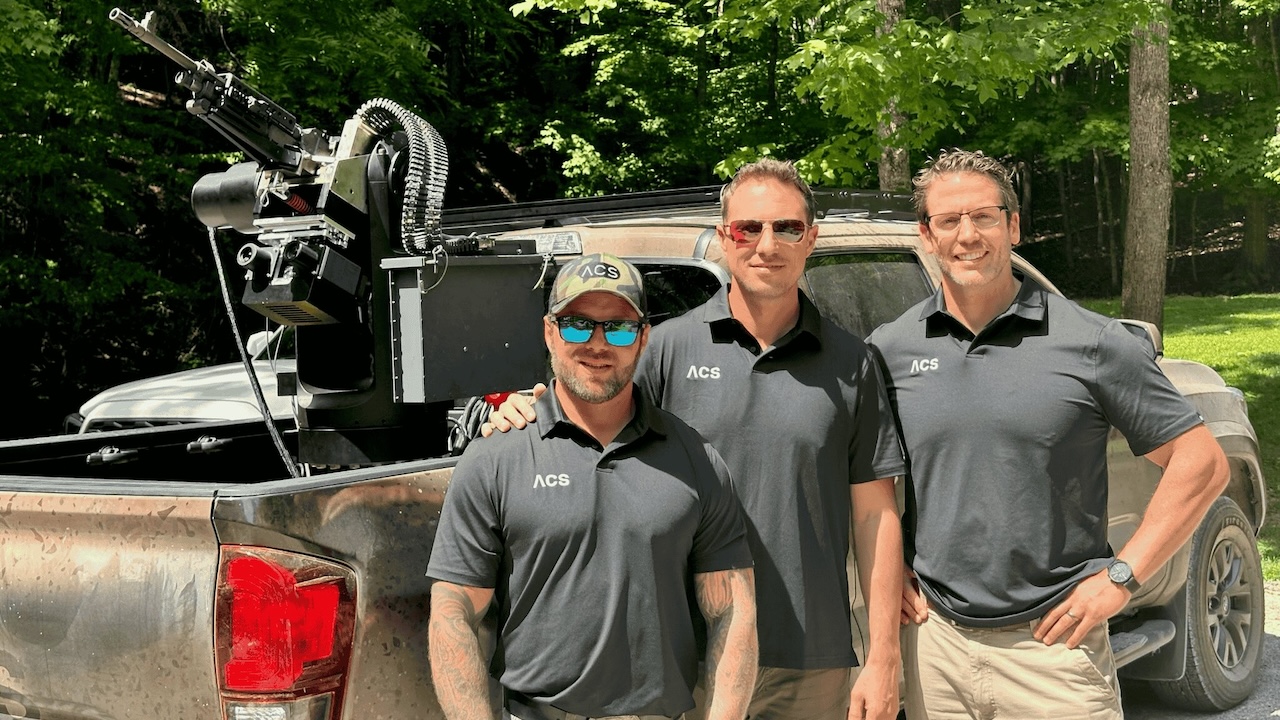
Allen Control Systems, a defense technology company that builds autonomous weapon stations for military use, has raised $200 million in a Series B funding round, valuing the company at $2.2 billion. The Austin, Texas-based startup was co-founded by CEO Mike Wior, President Steve Simoni, and CTO Luke Allen, three entrepreneurs who crossed paths in the restaurant technology industry before turning their attention to defense.
The funding comes at a time when cheap commercial drones have become a serious military problem. In conflicts across Ukraine and the Middle East, low-cost weaponized drones have proven capable of destroying equipment worth many times their price. Existing air defense systems, built to intercept jets and cruise missiles, are not well suited to this kind of threat. The global counter-drone market was valued at $6.64 billion in 2025 and is expected to reach $20.31 billion by 2030, growing at 25.1% per year. In fiscal year 2026, the Pentagon requested $3.1 billion specifically for counter-drone capabilities and $13.4 billion for autonomous systems overall, both figures significantly higher than in previous years.
The Series B was led by Smash Capital, with Craft Ventures, Rally Ventures, Inspired Capital, and other existing investors also participating. The $2.2 billion post-money valuation signals investor confidence in the growing demand for AI-powered, kinetic counter-drone technology.
How ACS Approaches the Drone Problem Differently
Most counter-drone systems today rely on missiles or electronic jamming. Missiles are expensive and exist in limited supply. Jamming can be defeated by drones that navigate without radio signals. ACS built Bullfrog around a different idea: take machine guns that militaries already own and use AI to make them accurate enough to shoot down drones automatically.
“Global demand for remote weapon stations has reached unprecedented levels as governments recognize kinetic defeat as the most reliable solution against low-cost weaponized drones,” said Steve Simoni, co-founder and President, ACS. “We are rapidly expanding our advanced manufacturing so we can get systems into the field faster.”
Bullfrog works without radar, which matters on the battlefield because radar broadcasts a position and can give away a unit’s location. The system handles the full process of detecting, tracking, and engaging a drone target on its own, without a human operating the weapon directly. This sequence is what the company refers to as the full kill chain. Bullfrog is rated to handle threats up to Group 3 UAS, a category covering larger tactical drones. During Technology Readiness Experiment 2026, known as T-REX 26-1 and run by the U.S. Department of War, the system recorded a 100 percent success rate.
How ACS Plans to Use the $200 Million
Most of the new capital will go toward manufacturing. ACS has already expanded its production facilities in Austin, Texas, and the company is focused on getting more Bullfrog systems to the U.S. military and allied partners as quickly as possible.
“Drone threats are growing faster than traditional air defense systems can meet them. Today, we are at risk of a catastrophic strike both abroad and at home,” said Mike Wior, co-founder and CEO, ACS. “Bullfrog provides governments with a scalable and affordable solution that leverages our nearly unlimited supply of bullets all over the world, compared to scarce and expensive missiles and interceptors. This funding helps us scale production to meet the urgent demand from the U.S. and allied partners.”
ACS also plans to develop new product lines beyond Bullfrog. The company has contracts through Joint Interagency Task Force 401, a U.S. government body set up to counter unmanned systems, and has customers among allied militaries. Bullfrog is already deployed with the U.S. Army and U.S. Navy.
The Founders: From Restaurant Tech to Defense
None of the three co-founders came from a traditional defense background. Mike Wior previously co-founded Omnivore, a restaurant point-of-sale transaction network and marketplace that expanded to more than 37,000 locations before being acquired by Olo. Steve Simoni, Luke Allen, and Greg Jaworski co-founded Bbot, a software and robotics restaurant technology startup that DoorDash acquired in 2022.
What sets Simoni and Allen apart is their military engineering background. Both served in the U.S. Navy as nuclear engineers, working on instrumentation and control systems for naval reactors. Their technical experience in robotics, computer vision, machine learning, and control systems gave them a foundation that transferred directly to building autonomous weapons.
ACS came out of their observation that drone warfare had moved from a specialized capability to a widespread threat faster than established defense companies were responding. Bullfrog is the company’s first product. It attaches to existing weapons, starting with the standard M240 machine gun, and uses computer vision and precision robotics to engage drone threats autonomously. No human needs to aim or pull the trigger.
The Investors Behind the Round
Smash Capital led the Series B. The firm focuses on enterprise software and technology companies. Craft Ventures, Rally Ventures, and Inspired Capital all returned from previous rounds, joined by other existing backers. The raise brings ACS to a funding level that supports sustained manufacturing growth and positions the company to pursue longer-term government contracts.
“Domestic critical infrastructure remains vulnerable to the threat posed by commercially available drones,” said Kevin Mayer, Founder and Partner, Smash Capital. “ACS has built an efficient, adaptable solution that’s perfectly tailored to meet this pressing national security challenge.”
“ACS has demonstrated a prescient understanding of the trajectory of modern warfare,” said Paul Szurek, Partner, Smash Capital. “The company has built a proven system that addresses a real operational problem, and they’ve shown they can move quickly from development to deployment.”


