



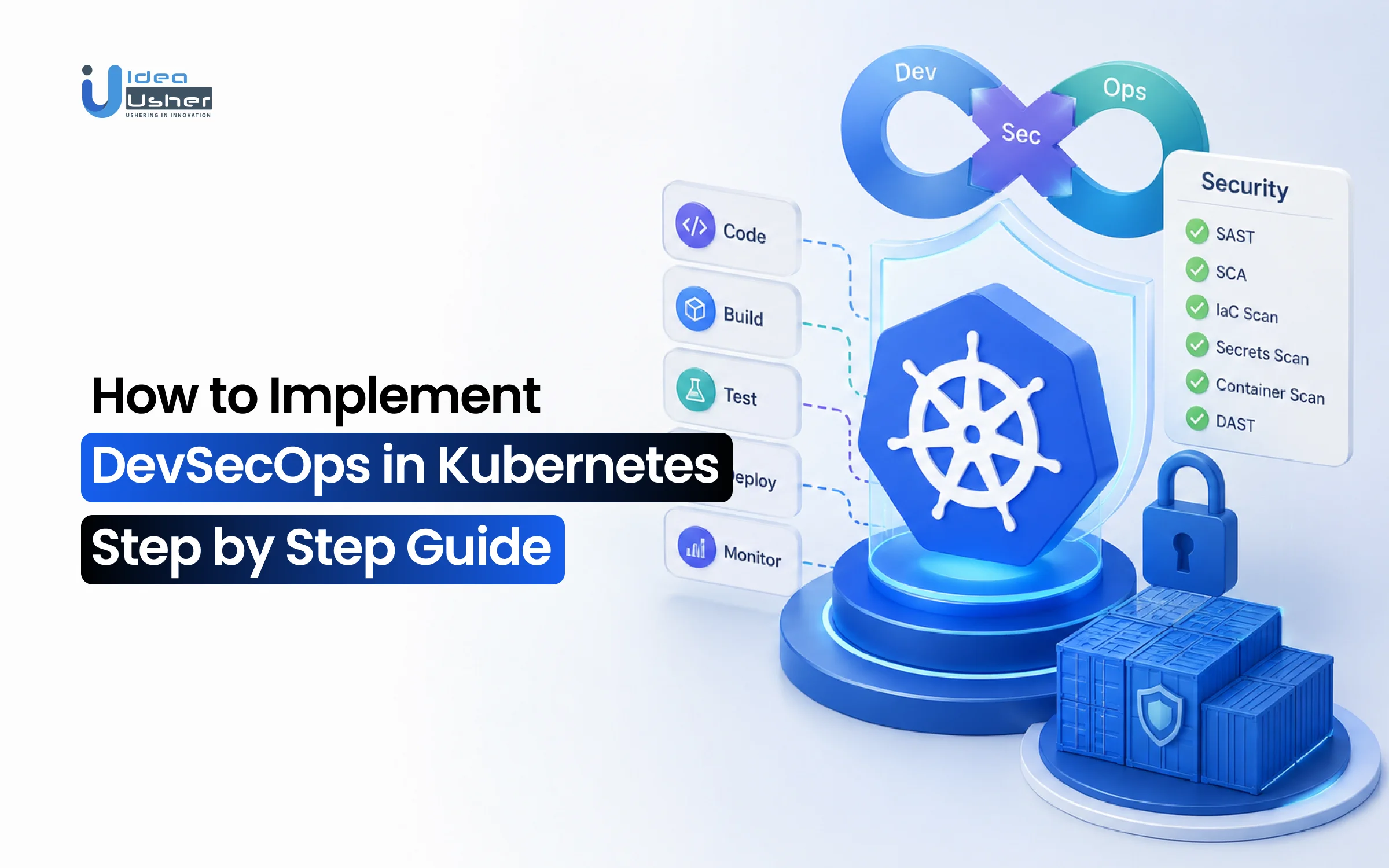
Key Takeaways
- Kubernetes environments become vulnerable when deployment speed outpaces security processes, making DevSecOps essential for infrastructure.
- Security integrates into CI/CD pipelines through automation, image scanning, runtime monitoring, and secure access controls.
- Major Kubernetes security risks include misconfigurations, weak RBAC policies, exposed secrets, runtime attacks, and compliance challenges.
- A structured DevSecOps approach helps businesses strengthen Kubernetes security while maintaining deployment speed and scalability.
- How Idea Usher helps businesses implement DevSecOps in Kubernetes with automated policy enforcement and pre-vetted security experts.
What happens when deployment pipelines move faster than security reviews can keep up? In Kubernetes environments, vulnerabilities often scale as quickly as applications. Traditional security models were built for static infrastructure and slower release cycles, but Kubernetes changed that entirely. Containers are created and destroyed within minutes, CI/CD pipelines deploy continuously, and a single misconfiguration can affect entire environments before teams detect it. Security can no longer function as a final checkpoint in cloud-native systems.
This shift is driving businesses toward DevSecOps-focused Kubernetes architectures, where security is integrated into development, deployment, and runtime operations from the beginning. The goal is not just preventing attacks, but maintaining a secure infrastructure without slowing releases or operational agility. For growing cloud-native platforms, this approach reduces risk, accelerates deployments, and removes inefficiencies caused by disconnected security processes.
We’ve helped teams integrate security directly into Kubernetes workflows, improving policy enforcement, reducing misconfigurations, and strengthening runtime protection. In this blog, we break down how to implement DevSecOps in Kubernetes step by step without slowing down modern deployment pipelines.
Why Kubernetes Security Breaks in Fast CI/CD Pipelines?
According to Strats Research, the global container and Kubernetes security market size was valued at USD 1510.01 million in 2023. It is projected to reach USD 12348.3 million by 2032, growing at a CAGR of 26.3% during the forecast period. This explosive growth is not merely a trend. It is a direct response to the systemic vulnerabilities created when high-velocity development outpaces infrastructure oversight. For entrepreneurs and investors, this represents a critical inflection point. The very agility that provides a competitive edge is often the primary source of catastrophic security failure.
Source: Strats Research
The friction between speed and safety occurs because Kubernetes was designed for orchestration and scalability, not as a turnkey security solution. In a modern CI/CD pipeline, code is committed, built, and deployed in minutes. This rapid movement often bypasses the manual checkpoints of earlier eras. When security is treated as a final gate rather than an integrated component of the pipeline, it inevitably breaks. The result is a security debt that accumulates with every deployment, eventually leading to vulnerabilities that are baked into the production environment itself.
The Rise of Cloud-Native Releases
The transition to cloud-native architectures has fundamentally altered the cadence of business. We have moved from quarterly releases to daily, or even hourly, deployments. For an organization looking to dominate a market, this speed is a necessity. However, from an architectural standpoint, cloud-native release cycles introduce a level of complexity that traditional frameworks are ill-equipped to handle.
- Ephemerality: Containers may only live for minutes. Traditional scanning tools that rely on periodic IP-based discovery cannot track assets that disappear before a scan even begins.
- Infrastructure as Code (IaC): Security is no longer just about firewalls. It is about the YAML files and Helm charts that define the environment. A single line of code in a manifest can inadvertently expose an entire cluster.
- Microservices Proliferation: Instead of securing one monolithic gateway, security teams must now secure the East-West traffic between hundreds of interconnected services.
Strategic investors must recognize that in this environment, security cannot be a standalone department. It must be a programmable, automated function of the release cycle. Without this integration, the speed of deployment becomes a liability rather than an asset.
Why Security Teams Fail to Adapt
Most traditional security teams are operating with a legacy mindset centered on perimeter defense and manual auditing. In the context of Kubernetes, this approach is mathematically impossible to scale. When developers trigger dozens of automated deployments per day, a security team relying on manual ticket reviews or weekly vulnerability reports becomes the ultimate bottleneck. The disconnect is often cultural and technical. Traditional teams are used to locking down assets, whereas Kubernetes thrives on dynamic resource allocation.
- Skill Gap: There is a significant shortage of professionals who understand both the nuances of Kubernetes orchestration and the intricacies of offensive security.
- Tooling Misalignment: Legacy security suites often lack visibility into the container runtime or the Kubernetes API server, leaving blind spots where attackers can pivot internally.
- Velocity Mismatch: If the security audit takes 48 hours but the deployment cycle is 30 minutes, the business will inevitably choose to bypass security to meet market demands.
For an entrepreneur, the investment should not just be in more personnel, but in the automation of the Security-as-Code philosophy to bridge this widening gap.
The Risk of a Single Misconfiguration
In a Kubernetes cluster, security is only as strong as the weakest deployment. Because containers share the underlying host kernel, a single misconfiguration can lead to a breakout scenario, where an attacker gains access to the entire node and, eventually, the entire cluster. This is not theoretical. It is a common reality in modern breaches.
Consider a developer who, in the rush to meet a deadline, runs a container as a privileged user to solve a permissions error. This single decision effectively grants the container the same rights as the host machine.
- Credential Theft: An attacker who compromises that container can scrape the Kubernetes API for service account tokens.
- Lateral Movement: From one compromised pod, an attacker can move across the network to access sensitive databases or secret stores that were never intended to be exposed.
- Resource Hijacking: Beyond data theft, misconfigured clusters are prime targets for crypto-jacking, where unauthorized containers drain expensive cloud resources, leading to massive, unexpected bills for the enterprise.
The Hidden Cost of Reactive Security
The financial implications of reactive security go far beyond the immediate cost of a data breach. For investors, the hidden costs represent a slow erosion of enterprise value and operational efficiency. When security is reactive, the organization is trapped in a perpetual cycle of fire drills.
- Operational Friction: Retrofitting security into a live production environment is exponentially more expensive than addressing it during the design phase. It requires emergency patches, downtime, and the diversion of top engineering talent away from revenue-generating features.
- Regulatory Penalties: With the tightening of global data privacy laws, a single Kubernetes misconfiguration that leaks sensitive information can result in fines that scale with global turnover.
- Reputational Churn: For B2B platforms, security is a core part of the product value proposition. A security failure during the scaling phase can lead to a loss of trust that takes years to rebuild, often resulting in increased customer churn and a lower valuation during exit or subsequent funding rounds.

What Does DevSecOps Mean in Kubernetes?
DevSecOps is the practice of embedding security logic directly into the software development lifecycle, ensuring that protection is a programmable, automated function rather than a manual bottleneck. In the dynamic world of Kubernetes, where pods spin up and down in seconds, traditional perimeter-based security fails.
By treating security as code, entrepreneurs can create a set of automated guardrails that guide an application from a developer’s laptop to a production cluster, ensuring that security keeps pace with innovation without compromising the speed of market delivery.
1. Security in the Deployment Lifecycle
The traditional model of security is a gate at the end of a long road. In Kubernetes, that road has been replaced by a continuous loop. Moving security into this lifecycle, often called shifting left, means identifying vulnerabilities at the moment of creation. This proactive integration transforms security from a reactive bottleneck into a core driver of engineering velocity.
- Code Analysis: Automated tools scan application code and configuration files the moment a developer pushes a change.
- Image Governance: Every container image is scanned for known vulnerabilities (CVEs) and checked against a whitelist of approved base images before it ever reaches a registry.
- Policy Enforcement: Admission controllers act as the final check, automatically rejecting any deployment that does not meet pre-defined security standards, such as running as a root user.
By moving these checks earlier, the cost of fixing a bug drops significantly. Finding a configuration error in development costs almost nothing. Finding that same error after a breach in production can cost an enterprise its entire reputation.
2. DevSecOps vs. Traditional DevOps
While DevOps focuses on the union of development and operations to increase delivery speed, DevSecOps introduces a third, non-negotiable dimension: accountability. In a standard DevOps model, security is often an external auditor. In DevSecOps, the responsibility is distributed.
| Feature | Traditional DevOps | Kubernetes DevSecOps |
| Primary Goal | Velocity and Stability | Velocity, Stability, and Integrity |
| Security Role | Reactive and Perimeter-based | Proactive and Embedded |
| Feedback Loop | Performance metrics | Security and compliance telemetry |
| Ownership | Dev and Ops teams | Shared responsibility across all stakeholders |
In this framework, developers are empowered with tools that provide real-time feedback. They no longer wait for a report from the security team. Instead, their IDE or CI pipeline tells them immediately if a package they have imported is unsafe. This creates a culture of security where every team member is an active participant in protecting the platform.
3. Layers of Security Automation
To secure a Kubernetes environment effectively, automation must occur across several distinct layers. Investors should look for platforms that address the full stack of the container journey. A comprehensive multi-layered defense ensures that security remains resilient even as the infrastructure scales in complexity.
The 4C Security Model: Cloud, Cluster, Container, and Code.
- Cloud Layer: Automation ensures the underlying virtual machines or managed services are hardened and that Identity and Access Management (IAM) roles follow the principle of least privilege.
- Cluster Layer: This involves securing the Kubernetes API and ensuring that network policies are in place to prevent unauthorized communication between microservices.
- Container Layer: Automation here focuses on the runtime. Tools monitor for suspicious behavior within a running container, such as a process attempting to modify a sensitive system file.
- Code Layer: This is the most granular level, where application-level security, such as encryption and input validation, is verified through automated testing suites.
3. Security Across CI/CD Workflows
Strategic security placement within the CI/CD pipeline ensures that no dark or unvetted code reaches the user. A well-designed workflow looks like a filter that becomes progressively finer as the code moves toward production. By automating these checks at every stage, businesses can achieve the dual goals of rapid deployment and uncompromising integrity.
The Build Phase
During the build, security focuses on the supply chain. This means verifying the signatures of third-party libraries and ensuring that the container build process is clean. If a developer attempts to include a library with a critical vulnerability, the build fails immediately, preventing the poisoned image from ever being created.
The Deploy Phase
As the code moves to deployment, the focus shifts to the environment. The CI/CD tool checks the Kubernetes manifest files. Does the deployment limit the CPU and memory it can use? Does it have a defined network policy? This is where the platform ensures that the application will be a good citizen within the cluster, unable to interfere with other services.
The Runtime Phase
Security does not stop once the code is live. Continuous monitoring tools provide a feedback loop, feeding data back into the development cycle. If a new vulnerability is discovered in an existing image, the system triggers an automated alert or an auto-remediation workflow to patch the running service without human intervention. This persistent vigilance is what defines a mature, investor-grade DevSecOps strategy.
Why Kubernetes Environments Become Security Risks?
The inherent complexity of Kubernetes is its greatest strength and its most significant security liability. While it enables massive scale, it also creates a vast attack surface where minor misconfigurations can lead to cascading failures. Since Kubernetes is not secure by default, a rigorous, automated approach to configuration is essential to prevent this high-performance engine from becoming a catastrophic business liability.
1. Container Vulnerabilities
The journey from a developer workstation to a production cluster is fraught with opportunities for compromised code to slip through. Container images often contain bloated libraries, outdated packages, and known vulnerabilities that act as dormant threats. Without a standardized, automated scanning process, these hidden risks move silently through the pipeline until they become active liabilities in your live environment.
- Supply Chain Contamination: Using unverified public images can introduce backdoors or malware into your environment.
- Vulnerability Aging: A container that was secure at the time of the build may become vulnerable a week later as new exploits are discovered.
- Layered Risks: Vulnerabilities can hide deep within the file system layers of an image, making them difficult to detect without deep recursive scanning.
Investment should be directed toward automated image signing and continuous scanning registries that prevent poisoned containers from ever being scheduled on a node.
2. Weak RBAC and Privilege Escalation
Role-Based Access Control is the primary mechanism for managing permissions in Kubernetes, yet it is frequently misconfigured due to its granular complexity. In many startups, the default is to provide cluster-admin rights to simplify development, creating a massive security hole.
The Principle of Least Privilege: Every service account and user should have only the minimum permissions necessary to perform its specific function, and nothing more.
When RBAC is weak, an attacker who compromises a single low-level pod can move laterally. They might list all secrets in the namespace or, worse, escalate their privileges to take over the entire cluster management. Audit logs often reveal that privilege escalation is the most common precursor to a full-scale data exfiltration event.
3. Insecure API Server Configurations
The API Server is the brain of the Kubernetes cluster. If it is exposed or improperly secured, the entire cluster is effectively open to the public. High-profile breaches often occur because the API server was left accessible to the internet without robust authentication. This single point of failure serves as the ultimate gateway for attackers, making its hardening the most critical priority in any infrastructure security strategy.
Critical API Vulnerabilities:
- Anonymous Access: Allowing unauthenticated requests to the API server is a recipe for immediate exploitation.
- Insecure Ports: Leaving non-authenticated ports open for debugging purposes provides a direct path for attackers to bypass standard security controls.
- Lack of Rate Limiting: This leaves the brain of your cluster vulnerable to Denial of Service attacks, which can paralyze your entire service infrastructure.
4. Secrets Exposure Across Clusters
Kubernetes Secrets are designed to store sensitive information like passwords, API keys, and certificates. However, the term Secret is somewhat misleading, as by default, they are often only Base64 encoded rather than encrypted at rest. This lack of native encryption means that any user or process with access to the cluster database can easily decode and exploit these credentials.
| Exposure Risk | Impact | Mitigation |
| Git Leakage | Secrets committed to version control. | Use secret-scanning hooks in CI/CD. |
| Env Variable Exposure | Secrets visible in pod descriptions. | Use volume mounts for secrets instead. |
| Etcd Access | Direct access to the cluster database. | Enable encryption at rest for the Etcd store. |
Strategic investors must ensure that the platform integrates with a dedicated Secret Management system rather than relying on native Kubernetes defaults.
5. Runtime Attacks Inside Pods
Security at the boundary is not enough. Runtime security focuses on what happens after a container is already running. Modern attackers specialize in living off the land, using legitimate tools already present in the container to execute their scripts. A runtime attack might involve a process suddenly attempting to open a network connection to an unknown external IP or a pod trying to modify its own root file system.
Without real-time behavioral monitoring, these activities go unnoticed. Implementing eBPF-based monitoring allows for deep visibility into system calls, enabling the platform to kill suspicious pods the millisecond an anomaly is detected.
6. Compliance in Multi-Cloud Environments
For businesses operating across multiple cloud providers, maintaining a consistent compliance posture is a significant challenge. Regulatory frameworks like SOC2, HIPAA, or GDPR require strict evidence of security controls that are often difficult to pull from dynamic Kubernetes clusters.
The risk here is configuration drift. A security policy that is enforced on one cloud might be missing or different on another. This inconsistency leads to audit failures and legal exposure. Automation is the only viable solution here. Using a centralized policy engine ensures that no matter where the cluster lives, it adheres to the same global compliance standards. This consistency is vital for maintaining the audit-ready status that high-value enterprise clients demand.
Business Risks of Poor Kubernetes Security
For an organization scaling on cloud-native infrastructure, inadequate security is a direct threat to financial health and operational continuity. In the interconnected world of Kubernetes, a single vulnerability creates a ripple effect that can paralyze an entire business model, making the adoption of a rigorous DevSecOps framework an essential insurance policy for digital assets.
Failing to secure the orchestration layer effectively puts a company’s valuation, market position, and regulatory standing at risk, as the cost of automated prevention is a mere fraction of the capital required to remediate a full-scale production breach.
1. Downtime From Compromise
In a high-availability environment, downtime is the ultimate enemy of ROI. When a container is compromised, the standard response is often to shut down affected pods or isolate network segments, leading to immediate service degradation. This reactive containment, while necessary, effectively turns a security breach into a self-inflicted denial-of-service that halts revenue generation.
- SLA Breaches: For SaaS providers, downtime triggers financial penalties and service credits owed to clients.
- Operational Paralyzation: If the orchestration layer is targeted, the ability to deploy fixes or scale to meet demand is lost.
- Resource Drain: Engineering teams are forced to pivot from building revenue-generating features to emergency forensic analysis.
2. Compliance and Audit Failures
Modern businesses operate under a microscope of regulatory scrutiny. Kubernetes environments, due to their dynamic and ephemeral nature, are notoriously difficult to audit manually. Without automated, continuous monitoring of these fleeting assets, companies often find themselves unable to provide the point-in-time evidence required to satisfy stringent institutional auditors.
The Compliance Gap: If you cannot prove that your workloads are running in a hardened environment with strict access controls, you are already in violation of frameworks like SOC2, HIPAA, or PCI-DSS.
A failure to maintain continuous compliance leads to more than just a failed audit. It can result in the revocation of operating licenses and the inability to close deals with enterprise-grade customers who require rigorous security documentation.
3. Delayed Product Releases
Nothing kills market momentum faster than a security stop-ship order. When a vulnerability is discovered late in the CI/CD pipeline, the entire release cycle grinds to a halt, creating a bottleneck that affects every department. This sudden friction forces engineers into expensive, high-pressure rework that pulls focus away from the innovation necessary to stay ahead of the competition.
- Reactive Re-Engineering: Developers must backtrack to fix architectural security flaws that should have been caught during design.
- Marketing Deferment: Product launches and partner integrations are pushed back, giving competitors a window to capture market share.
- Capital Burn Rate: Every week a release is delayed is another week of burning through capital without the intended growth in user base or revenue.
4. Financial Impact of Breaches
The cost of a breach in a Kubernetes environment is often higher than in legacy systems due to the sheer density of data and the potential for resource hijacking. Because these clusters aggregate vast amounts of sensitive logic and compute power into a single control plane, a successful exploit can lead to astronomical cloud overage fees and deep-reaching operational damage.
| Expense Category | Immediate Impact | Long-term Impact |
| Forensics & Recovery | Emergency consultant fees. | Infrastructure overhaul costs. |
| Cloud Overages | Massive bills from crypto-jacking. | Higher baseline infrastructure spend. |
| Legal & Notification | Mandatory data breach disclosure. | Class-action litigation defense. |
| Regulatory Fines | Immediate statutory penalties. | Increased oversight and monitoring. |
Strategic capital allocation must prioritize security automation to prevent these black swan financial events that can zero out years of profit and stall growth.
5. Loss of Customer Trust
In the SaaS world, trust is the only currency that truly matters. Customers are not just buying software; they are entrusting their most sensitive data to your infrastructure. A public security incident involving your Kubernetes cluster sends a signal that your platform is a liability. The damage to a brand’s reputation is often permanent.
Once a platform is labeled insecure, the cost of customer acquisition skyrockets, as prospects require longer sales cycles and more extensive proof of security. This erosion of confidence translates to a lower terminal value for the company. Robust, transparent Kubernetes security is the most effective way to protect the integrity of the brand and ensure customer retention.
Core Components of a Kubernetes DevSecOps Stack
A strong Kubernetes security posture is not built around a single tool. It depends on a layered ecosystem where security is integrated directly into development, deployment, and runtime operations. Organizations implementing DevSecOps successfully embed protection across the entire software delivery lifecycle, allowing teams to maintain deployment speed while strengthening cluster security and operational resilience.
1. Secure CI/CD Architecture
The pipeline is the primary gateway to your production environment. A secure architecture treats every stage of the build as a checkpoint, ensuring that only code that meets rigorous security standards can progress. By embedding automated validation at each transition, you transform the delivery process into a continuous shield that identifies and neutralizes threats long before they reach the cluster.
- Automated Gatekeeping: Integrating security checks directly into the CI/CD flow prevents “dark code” from being deployed.
- Artifact Signing: Using tools like Cosign to sign container images ensures that the image running in production is exactly what was built and tested.
- Branch Protection: Enforcing peer reviews and mandatory status checks before merging code into main branches.
2. Image Scanning and Validation
Container images are the building blocks of your applications, but they can also be carriers for vulnerabilities. Scanning must be continuous, as a secure image today may have a newly discovered vulnerability tomorrow. This persistent oversight ensures that your registry remains a trusted source, automatically flagging or blocking images as soon as a new CVE is published to the global database.
| Scanning Phase | Tooling Example | Objective |
| Development | IDE Plugins | Catch vulnerabilities as code is written. |
| Build | Trivy / Grype | Identify CVEs in OS packages and language libraries. |
| Registry | Harbor / Quay | Perform periodic scans on stored images. |
3. Policy-as-Code Systems
Policy-as-Code allows security teams to define guardrails that are automatically enforced by the Kubernetes admission controller. This ensures that no deployment can violate security standards, regardless of who performs the update. By codifying these rules, you eliminate manual review inconsistencies and provide developers with immediate feedback when a configuration fails to meet safety requirements.
Proactive Governance: Instead of reacting to a misconfiguration after it’s live, a policy engine like OPA Gatekeeper or Kyverno can reject a deployment that lacks resource limits or attempts to run as a privileged root user.
4. Runtime Threat Detection
Since security at the perimeter can never be 100% guaranteed, you must monitor the behavior of workloads in real-time. Runtime security identifies anomalies that occur after a pod has been successfully scheduled. By continuously analyzing system calls and process activities, this layer acts as a final safety net that detects and stops active exploits that bypassed every previous static check in the pipeline
Key Behavioral Indicators:
- Unexpected Binary Execution: A web server suddenly running a shell script or a package manager.
- Suspicious Network Traffic: A pod attempting to reach out to known malicious IPs or internal metadata services.
- File System Integrity: Unauthorized attempts to modify sensitive system files like /etc/shadow.
5. IaC Security Controls
In a Kubernetes environment, your infrastructure is defined by YAML or Terraform files. Securing these templates is just as important as securing the application code itself, as a single misconfigured manifest can expose an entire cluster. By applying static analysis to these definitions, you can proactively block insecure configurations like excessive privileges or open ports before they are ever realized in your live environment.
- Static Analysis: Use tools to scan manifests for “over-permissioned” configurations before they are applied.
- Immutable Infrastructure: Discourage manual kubectl changes in favor of a GitOps approach, where every change is tracked and audited in a version control system.
- Configuration Hardening: Stripping unnecessary capabilities (like CAP_SYS_ADMIN) from container definitions by default.
6. Observability and Monitoring
You cannot secure what you cannot see. Modern security monitoring leverages the deep telemetry provided by Kubernetes to create a comprehensive view of the environment’s health and security status. Effective observability isn’t just about collecting logs; it’s about correlation. By merging network flow logs, audit logs, and application metrics, security teams can trace a suspicious event back to its source.
Utilizing eBPF (extended Berkeley Packet Filter) technology allows for deep-kernel visibility without the performance overhead of traditional sidecar proxies, providing a high-fidelity stream of every system call and network packet moving through the cluster.
Step-by-Step Process to Implement DevSecOps in Kubernetes
Building a DevSecOps culture within Kubernetes is an iterative journey that transforms security from a final hurdle into an automated, continuous service. At IdeaUsher, we facilitate this transformation by providing pre-vetted DevSecOps talent that ensures every container, configuration, and cluster resource is validated against organizational standards throughout its lifecycle.

1. Audit Infrastructure
Before we deploy new tools, we help you understand the current state of your environment. An audit identifies where the fence is broken before we build a gate. By evaluating your existing workloads and configurations, we pinpoint hidden vulnerabilities that could undermine your entire DevSecOps strategy.
- Identifying Security Gaps: We use tools to scan existing clusters for over-privileged service accounts or pods running as root.
- Reviewing CI/CD Practices: Our specialists map out the path from code to production to find dark stages where security checks are entirely absent.
2. Secure the Supply Chain
The journey begins at the source. If the ingredients are tainted, the final product will never be secure. By establishing a chain of trust from the very first line of code, we ensure that malicious or vulnerable components are filtered out before they can ever infiltrate your supply chain.
Supply Chain Rule: We never trust a base image or a third-party dependency without local verification.
The Validation Workflow:
- SCA: We check application libraries for known vulnerabilities.
- Image Provenance: We use digital signatures to confirm that an image was created by a trusted build system.
- Clean Registries: We prune unused images that serve as unnecessary attack surfaces.
3. Integrate CI/CD Security
We ensure security is an automated quality gate in your pipeline. If a build does not pass the security test, it does not reach the cluster. This systematic approach ensures that no high-risk code enters production, allowing your team to maintain rapid deployment cycles without compromising the integrity of your environment.
- Static and Dynamic Checks: We run SAST on your source code and DAST on temporary staging environments.
- Automated Blocking: We configure your pipeline to fail the build automatically if a critical vulnerability is detected, forcing an immediate fix.
4. Implement Access Controls
Kubernetes is powerful, which makes its access controls, like the Role-Based Access Control, the most critical defensive layer we manage for you. By fine-tuning these permissions, we eliminate unnecessary broad access and ensure that each user and service operates strictly within its designated boundaries.
- Hardening RBAC: We follow the Principle of Least Privilege. If a developer only needs to view logs, we do not give them edit permissions.
- Namespace Isolation: We use namespaces to create logical boundaries between teams, ensuring a compromise in one does not sink the other.
5. Protect Sensitive Data
Hardcoded passwords in YAML files are a recipe for disaster. We decouple secrets management from the application logic. By integrating robust vaulting solutions, we ensure that sensitive credentials remain encrypted and are only injected into your workloads at the precise moment they are needed.
| Secret Method | Risk Level | Recommended Action |
| Hardcoded in Code | Critical | We remove these and rotate all compromised keys. |
| Base64 K8s Secrets | Medium | We use at-rest encryption for the cluster database. |
| External Vaults | Low | We integrate with HashiCorp Vault or Cloud KMS. |
6. Enforce Policy-as-Code
Policy-as-Code acts as an automated bouncer for your cluster, and we configure it to reject any request that does not meet safety requirements. This real-time enforcement guarantees that your security standards are non-negotiable, preventing human error from introducing risky configurations into your production environment.
- Preventing Misconfigurations: We automatically reject pods that do not have resource limits or those attempting to mount sensitive host paths.
- Standardizing Teams: We ensure every team follows the same fundamental security baseline through global policy enforcement.
7. Runtime Threat Detection
Since no pre-deployment check is perfect, we place a smoke detector inside the cluster to catch active exploits. This proactive monitoring allows us to identify and neutralize sophisticated threats in real time, ensuring that even the most subtle anomalies are addressed before they can escalate into a full-scale breach.
- Monitoring Pod Activity: We look for drift, which includes processes running inside a container that were not part of the original image.
- Detecting Lateral Movement: We use network policies to flag if a web server suddenly tries to talk to a sensitive database it has no business accessing.
8. Continuous Compliance
Compliance is not a one-time event; we maintain it as a continuous standard for your platform. By automating the evidence collection and auditing process, we ensure your infrastructure stays continuously aligned with industry regulations and internal security benchmarks without manual intervention.
The Compliance Checklist:
- Automated Reporting: We generate real-time reports that map your cluster state to frameworks like SOC2 or HIPAA.
- Tracking Drift: We use GitOps tools to detect when a manual change has been made to the infrastructure and automatically revert it to the known good state.
Common Mistakes Companies Make With DevSecOps
Shifting to a DevSecOps model is as much about cultural change as it is about technical tooling. At IdeaUsher, we see many organizations stumble because they attempt to bolt security onto existing workflows. We provide pre-vetted talent that helps you avoid these pitfalls by integrating protection into the core of your Kubernetes operations.
1. Security as a Final Task
The most frequent error is maintaining the traditional security checkpoint at the very end of the release cycle. When security is treated as a final gate, it inevitably becomes a bottleneck that delays launches. We help you eliminate this friction by embedding security checks into every stage of development, ensuring that issues are resolved as they arise rather than stalling your deployment at the finish line.
The Friction Paradox: The later a vulnerability is found, the more expensive it is to fix. We help your team shift security left, ensuring that protection is built-in from the start so developers do not face high-pressure rework later.
2. Over-Reliance on Scanners
While vulnerability scanners are essential, they are not a complete strategy. Relying solely on static scans creates a false sense of security because they only identify known vulnerabilities in libraries. We complement these tools by implementing deep logic reviews and behavioral analysis, ensuring your applications are protected against complex threats that simple database lookups often miss.
- The Gap: We bridge the gap where scanners miss logical flaws in application code.
- The Noise: Our experts tune your systems to prevent alert fatigue from thousands of low-priority findings.
- The Blind Spot: We implement strategies that account for how an application behaves in a live cluster, not just in the registry.
3. Lack of Runtime Visibility
Many teams focus heavily on the build process but lose sight of the application once it is deployed. If your strategy stops at the push to production phase, you are blind to active exploits. We bridge this gap by deploying advanced runtime protection that maintains a watchful eye on your live traffic, ensuring that any malicious activity is neutralized the moment it surfaces.
| Feature | Pre-Deployment Focus | Runtime Focus |
| Visibility | We analyze code and images. | We monitor system calls and flows. |
| Detection | We identify known CVEs. | We spot zero-day exploits. |
| Response | We block the build. | We isolate pods or terminate processes. |
4. Configuration Drift
In a fast-paced environment, manual quick fixes often bypass the standard CI/CD process. This leads to configuration drift, where the live state of the cluster no longer matches your secure templates. We help you implement GitOps workflows that automatically identify and remediate these undocumented changes before they become security holes.
5. Lack of Automation
Manual security processes cannot keep up with the scale of modern Kubernetes. Attempting to manually review every YAML change leads to human error and significant delays. We solve this by automating your compliance guardrails, allowing your infrastructure to scale rapidly while our pre-vetted experts ensure every configuration remains airtight and error-free.
Why we prioritize automation:
- Speed: We build pipelines that move at the speed of your business.
- Consistency: We replace inconsistent human reviews with automated policies that do not waver.
- Scale: We manage security for hundreds of microservices, a task that is physically impossible to do manually.
6. Using Generic Policies
Applying a one-size-fits-all security policy is a recipe for operational failure. We help you tailor your guardrails so that a dev cluster has the flexibility needed for testing while your production environment remains in total lockdown. By aligning security intensity with the specific risk profile of each environment, we ensure your developers stay productive without ever compromising the safety of your most sensitive assets.
Our Targeted Approach:
- Context Awareness: We configure policies that understand the sensitivity of data within specific namespaces.
- Service-Specific Rules: We ensure a front-end server and a back-end database do not share the same excessive permissions.
- Granularity: We provide the talent to design guardrails that match the specific risk profile of every workload you run.
Why Kubernetes DevSecOps Is Hard to Execute Internally?
Executing a robust DevSecOps strategy within a Kubernetes environment is a daunting task that often overwhelms internal teams. The shift from traditional monolithic security to a microservices-based model requires a level of specialization that many organizations struggle to maintain. At IdeaUsher, we simplify this complexity by providing pre-vetted talent that bridges the technical gap between development and security operations.

1. Shortage of Security Engineers
Finding experts who understand both the intricacies of container orchestration and the nuances of cybersecurity is a significant hurdle. There is a massive global talent gap for professionals who can navigate the specific security configurations of the Kubernetes API.
- The Talent Gap: Most DevOps engineers focus on availability, while security engineers focus on risk; finding someone who masters the overlap is rare.
- Our Solution: We connect you with specialized engineers who possess the deep expertise required to harden your clusters from day one.
2. Infrastructure Complexity
Unlike legacy systems, Kubernetes is a dynamic ecosystem where containers spin up and down in seconds. This creates a massive attack surface that is difficult to monitor without a deep understanding of cloud-native networking and storage. We provide the technical talent to implement granular observability and automated defenses that keep pace with these rapid changes, ensuring no ephemeral threat goes unnoticed.
| Infrastructure Type | Security Challenge | Our Approach |
| Traditional VM | Static IP and long-lived OS | Fixed perimeter defense |
| Kubernetes | Ephemeral pods and internal APIs | Identity-based micro-segmentation |
3. Changing Compliance Requirements
Staying compliant with standards like SOC2, PCI-DSS, or HIPAA is difficult when your infrastructure is in a state of constant flux. Traditional audit methods fail in a containerized world where the life of a pod may only be minutes. We help you automate the evidence collection process, ensuring your Kubernetes environment stays audit-ready without draining your internal resources.
4. Security and CI/CD Integration
Many organizations find it nearly impossible to insert security checks into their legacy pipelines without breaking the developer workflow. If the integration is clunky, developers will find ways to bypass it to meet deadlines. We solve this by providing specialists who refine your automation, ensuring that security becomes a silent, helpful partner in the development process rather than a disruptive obstacle
The Integration Rule: If a security check adds more than five minutes to a build, it will eventually be ignored or disabled by the engineering team.
We design seamless automated gates that act as a natural part of the build process, making security a frictionless experience for your engineering team.
5. Scaling Security Across Teams
As an organization grows from five developers to five hundred, maintaining a consistent security standard becomes a massive operational burden. What works for a single project often falls apart when applied across dozens of different microservices. We help you implement standardized, scalable security policies that ensure every team follows the same high-level protection protocols without manual intervention.
Why Hiring Kubernetes DevSecOps Talent Is Difficult?
Securing a Kubernetes environment requires a rare blend of infrastructure coding, security research, and operational experience. Most companies find that while they can hire for one of these areas, finding a professional who masters the intersection is nearly impossible. At IdeaUsher, we provide the pre-vetted talent needed to bypass the grueling recruitment cycle and secure your clusters immediately.
1. Rising Demand for Experts
The rapid shift to containerization has outpaced the security workforce, leaving major enterprises to compete for a tiny pool of specialized talent. This creates a market where critical roles remain vacant for months. We solve this by providing immediate access to ready-to-deploy experts, ensuring your security moves forward without being stalled by a sluggish hiring market.
- The Scarcity: For every ten DevOps roles, there is often only one qualified DevSecOps candidate.
- The Cost of Delay: Every day a seat remains empty is a day your production environment remains vulnerable to emerging threats.
2. DevOps vs. Security Depth
While many DevOps engineers master availability and scaling, they aren’t always trained to think like an attacker. Kubernetes security goes beyond writing YAML; it requires understanding kernel-level exploits and network isolation. Our specialists bridge this gap by applying an adversarial mindset to identify and patch deep-seated vulnerabilities that standard management might overlook.
The Skills Gap: A standard DevOps engineer might know how to deploy a pod, but a DevSecOps specialist knows how to prevent that pod from escalating privileges to take over the entire node.
3. Need for Specialization
Securing an enterprise-grade cluster isn’t a task for generalists. It requires deep knowledge of specific tools like OPA Gatekeeper, Kyverno, and Falco, along with the ability to manage complex RBAC policies at scale. We provide experts who have already mastered these tools, ensuring you don’t have to pay for an internal hire’s learning curve while your data is at risk.
4. Slow In-House Hiring
The traditional hiring process, spanning from sourcing and technical interviews to onboarding, can take three to six months. In the world of software delivery, that is an eternity. We bypass this timeline by providing elite engineers who integrate with your team instantly, turning months of searching into days of progress.
| Hiring Path | Time to Value | Risk Level |
| Traditional In-House | 3 to 6 Months | High (Wrong hire is costly) |
| IdeaUsher Talent | Immediate | Low (Pre-vetted specialists) |
5. High Retention Costs
Finding a DevSecOps engineer is hard, but keeping them is even harder. With salaries skyrocketing and poaching common in the industry, companies often lose their best talent just as they become critical to the project. We handle the retention and management, providing you with a consistent, reliable stream of expertise so your security posture never falters due to staff turnover.
In-House Team vs DevSecOps Staff Augmentation
Choosing between an internal team and staff augmentation is a pivotal decision for any company implementing a DevSecOps strategy. While in-house teams offer institutional knowledge, the technical demands of Kubernetes often outpace the speed of traditional hiring. At IdeaUsher, we provide the specialized talent that allows you to scale security at the same rate as your infrastructure.

1. Speed and Efficiency
Internal teams often face a steep learning curve when adapting legacy security to containerized workflows, which can lead to friction and slower release cycles. Staff augmentation eliminates this lag by embedding experts who already understand how to automate security within the pipeline.
- In-House: May struggle with integration, leading to security becoming a bottleneck.
- Augmentation: We provide engineers who implement frictionless, automated guardrails to keep your deployments moving.
2. Expertise and Experience
The knowledge required to secure a cluster, such as managing etcd encryption and network policies, is rare. Most generalist hires require months of training to reach the level of a cloud-native specialist. We bridge this expertise gap by providing seasoned professionals who carry these advanced certifications and hands-on experience, allowing you to bypass the learning curve and harden your environment immediately.
Expertise Check: Does your current team know how to defend against a container breakout? Our pre-vetted talent arrives with these skills on day one, ensuring your sensitive data is protected by those who have already mastered the environment.
3. Scaling and Support
As your cluster grows to a multi-region deployment, the security burden increases exponentially. An in-house team may become overwhelmed by the sheer volume of logs and alerts. We provide a scalable model where you can adjust expert support as your infrastructure expands, ensuring you are never understaffed during a growth phase.
4. Cost Comparison
Directly comparing the financial impact of different staffing models reveals the hidden costs associated with traditional employment. Beyond the base salary, internal hiring involves substantial overhead in the form of recruitment fees, benefit packages, and the continuous investment required for technical upskilling.
| Expense Factor | Internal Hire | Staff Augmentation |
| Sourcing | High HR overhead | Minimal (Pre-vetted) |
| Salary & Benefits | Full-time overhead | Flexible/Project-based |
| Training | Ongoing cost | Zero (Experts are ready) |
| Retention Risk | High market turnover | We manage the talent |
5. Time-to-Market
The difference between hiring a team and augmenting one is often measured in months of lost revenue. In the time it takes to onboard a single permanent lead, augmented experts could have already secured your entire pipeline. We help you turn months of administrative delay into days of active development, allowing you to hit your market windows with a production-ready platform.
What Idea Usher Does for Kubernetes DevSecOps?
Integrating security into a fast-moving Kubernetes environment requires more than just tools; it demands a strategic alignment of people and processes. We focus on bridging the gap between high-speed development and ironclad protection. By providing elite talent, we turn complex Kubernetes security into a seamless, automated reality for your organization.
1. Secure Deployment Pipelines
A secure pipeline is the foundation of any cloud-native strategy. We help you transition from manual checks to an automated Shift Left approach, catching security flaws before they ever reach your clusters. By embedding these checks directly into your existing workflow, we ensure that security becomes an automated gatekeeper that accelerates rather than hinders your delivery speed.
- Image Scanning: Automatic detection of vulnerabilities in container images.
- Secret Management: Securely injecting credentials without hardcoding them in YAML.
- Signature Verification: Ensuring only trusted, verified images are allowed to run.
2. End-to-End Automation
Manual intervention is the enemy of scale. We automate the entire security lifecycle, from initial configuration to runtime response, ensuring that your defense posture evolves as fast as your code. Our automated systems work around the clock to detect and remediate threats in real time, providing a consistent layer of protection that manual oversight simply cannot match.
The Automation Advantage: By replacing manual reviews with automated policy engines, we reduce human error significantly, allowing your team to focus on innovation rather than fire-fighting.
3. Hardening Infrastructure
Managing security for one cluster is difficult. Managing it across multiple clouds and regions is a monumental challenge. We specialize in hardening the underlying infrastructure to ensure consistent protection across your entire footprint. This unified approach eliminates security silos, creating a standardized and resilient defense layer regardless of where your workloads are hosted.
| Feature | Standard Setup | IdeaUsher Hardened |
| API Access | Often exposed or loosely restricted | Strictly guarded via OIDC and RBAC |
| Network | Flat network with open communication | Zero-trust micro-segmentation |
| Storage | Unencrypted data at rest | Full etcd and volume encryption |
4. Multi-Cloud Compliance
Whether it is SOC2, HIPAA, or PCI-DSS, maintaining compliance in a dynamic environment requires constant vigilance. We implement real-time compliance monitoring that acts as a continuous audit, so you never have to scramble before a deadline. Our experts set up automated reporting tools that provide a clear paper trail of every configuration change and access request.
5. Frictionless Releases
The biggest fear for any development lead is that security will become a bottleneck. We focus on Invisible Security. These are guardrails so well-integrated into the developer workflow that they feel like a natural part of the coding process. We design customized admission controllers that provide instant feedback to developers, allowing them to fix security issues in real-time without ever leaving their IDE.
What Idea Usher’s DevSecOps Developers Actually Do?
Modern security requires a proactive, hands-on approach where developers and security experts operate as a single unit. Our specialists don’t just offer advice; they integrate directly into your workflows to build, monitor, and defend your containerized ecosystem. By taking over the technical heavy lifting, we allow your core team to remain focused on product innovation while we handle the intricate layers of cloud-native protection.

1. Audit Infrastructure
Before we build, we analyze. Our developers perform deep-dive inspections of your current setup to find hidden misconfigurations that could lead to a breach. We examine everything from API server settings to unencrypted secrets, providing a clear roadmap of immediate risks. This ensures we are fixing core vulnerabilities rather than just layering tools on a shaky foundation.
2. Secure CI/CD Workflows
We transform your delivery pipeline into a fortress. By integrating security checks at every stage of the build, we ensure that no compromised code ever reaches production. This proactive approach turns your CI/CD process into a continuous shield, blocking vulnerabilities at the source before they can impact your live environment.
- Pre-commit Hooks: Scanning code for secrets before it leaves the developer’s machine.
- Pipeline Gates: Automatically failing builds that do not meet security thresholds.
- Artifact Signing: Ensuring only authorized binaries are deployed to your nodes.
3. Automate Container Scanning
Manual image reviews cannot keep up with modern deployment speeds. We implement automated scanning solutions that check every container layer for known CVEs and malware. Our systems provide real-time alerts to developers, allowing them to swap out vulnerable base images for secure versions before the deployment phase even begins.
4. Runtime Threat Monitoring
Static security is not enough because threats often emerge after a pod is already running. We deploy monitoring tools like Falco or Tetragon to observe system calls and network traffic in real time. This active surveillance ensures that even if a zero-day vulnerability is exploited, we can detect the breach and trigger an immediate automated response to neutralize the threat.
The Runtime Standard: If a container attempts to modify a sensitive system file or opens an unexpected network connection, our system detects it instantly and can automatically isolate the compromised pod.
5. Policy-as-Code Systems
Consistency is the key to enterprise security. We replace manual checklists with Policy-as-Code using tools like OPA or Kyverno. This allows your security rules to be version-controlled, tested, and enforced automatically across every cluster in your organization, regardless of the cloud provider.
6. Optimize for Secure Scaling
Security should never be an afterthought during growth. We ensure that as your infrastructure scales to meet demand, your security policies scale with it automatically. We build the automation that provisions new nodes with pre-hardened configurations, ensuring your attack surface remains small even as your footprint expands.
| Scaling Factor | Standard Practice | Our DevSecOps Approach |
| User Access | Shared admin accounts | Granular RBAC with Just-in-Time access |
| Networking | Open internal communication | Zero-trust with automated mTLS |
| New Nodes | Manual security hardening | Automated, secure-by-default provisioning |
Real-World Use Cases of Kubernetes DevSecOps
Theoretical frameworks are useful, but the true value of DevSecOps is proven in high-stakes, real-world environments. From protecting sensitive patient data to securing high-frequency financial transactions, the application of Kubernetes security varies significantly by industry.
Deployment is only half the battle. The other half is maintaining a defensive posture that can withstand the unique pressures of your specific market. Below are the primary ways our DevSecOps talent secures diverse enterprise landscapes.
1. Securing SaaS Platforms
For SaaS providers, uptime and multi-tenant isolation are the top priorities. We implement strict namespace isolation and network policies to ensure that one customer’s data can never be accessed by another. By deploying automated service meshes, we provide the mutual TLS (mTLS) encryption necessary to secure all internal traffic without requiring developers to change a single line of code.
2. Protecting Healthcare Cloud
In the healthcare sector, data integrity and privacy are non-negotiable. We help organizations build HIPAA-compliant Kubernetes environments by enforcing strict encryption for data both at rest and in transit. This specialized focus ensures that sensitive patient information remains shielded behind multiple layers of automated defense, meeting the highest standards of regulatory oversight without compromising system performance.
- Audit Logging: Implementing immutable logs to track every access request to sensitive patient records.
- Admission Controllers: Preventing the deployment of any container that does not meet strict security profiles.
- Vulnerability Management: Continuous patching of base images to protect against exploits targeting medical databases.
3. Managing FinTech Compliance
Financial institutions operate under a microscope of regulatory scrutiny. We bridge the gap between agile development and rigid compliance requirements like PCI-DSS by automating the evidence-collection process. This helps teams reduce manual compliance overhead while maintaining consistent audit readiness across environments.
| FinTech Challenge | Our DevSecOps Solution |
| Data Exfiltration | Egress filtering to block unauthorized data transfers |
| Insider Threats | Multi-factor authentication for all cluster operations |
| Audit Failures | Real-time compliance dashboards for instant reporting |
4. Scaling AI Platforms
AI and Machine Learning workloads require massive GPU resources and high-speed data access, which can create unique security blind spots. We secure the specialized “sidecar” containers and data pipelines used in AI training, ensuring that proprietary models and training sets remain confidential.
The AI Security Standard: As your AI models scale across hundreds of nodes, our automated policy enforcement ensures that your compute-heavy workloads remain isolated and protected from lateral movement attacks. This allows your data scientists to focus on training models while we secure the underlying infrastructure.
Signs Your Business Needs Kubernetes DevSecOps
Many organizations reach a tipping point where their Kubernetes infrastructure grows faster than their ability to protect it. When security becomes a reactive firefighting exercise rather than a proactive strategy, it is a clear indicator that your current model is no longer sustainable. Identifying these warning signs early can save your business from costly breaches and reputational damage.
Recognizing the symptoms of an insecure environment is the first step toward building a resilient system. If your team is experiencing any of the following challenges, it is time to integrate specialized security expertise like Idea Usher into your development lifecycle.
1. Frequent CI/CD Incidents
If security flaws are consistently discovered only after code has reached production, your pipeline is failing its most basic duty. Frequent hotfixes and emergency rollbacks due to vulnerabilities indicate a lack of automated guardrails. By shifting security left, we catch these issues at the commit stage, ensuring that only hardened, verified code moves forward.
2. Growing Cluster Complexity
As you move from a single cluster to a sprawling multi-cloud environment, manual configuration becomes impossible to manage. Complexity is the enemy of security because it creates blind spots that attackers are quick to exploit. Even small configuration inconsistencies across clusters can lead to serious compliance and access control risks.
- Symptom: Inconsistent security policies across different environments.
- Symptom: Difficulty tracking which users have access to which resources.
- Symptom: Overprivileged service accounts that increase your attack surface.
3. Manual Review Delays
Are your release cycles stalled because the security team has to manually approve every change? This friction often leads to shadow IT, where developers bypass security protocols just to meet deadlines. We replace these human bottlenecks with automated policy engines that provide instant feedback, allowing your team to move at the speed of cloud native development.
5. Compliance Pressure
Enterprise clients and regulators demand more than just a secure system. They require documented proof of compliance. If your team is spending weeks gathering data for audits, your process is broken. Manual compliance tracking often leads to incomplete records, delayed reporting, and increased operational pressure on internal teams.
| Compliance Burden | Standard Response | The DevSecOps Way |
| Data Collection | Manual log gathering | Automated, real-time reporting |
| Evidence | Screenshots and spreadsheets | Immutable, versioned audit trails |
| Validation | Annual spot checks | Continuous automated monitoring |
Export to Sheets
6. Lack of Runtime Visibility
Knowing your images are secure at build time is only half the battle. If you cannot see what is happening inside your containers once they are live, you are blind to modern threats like memory-only malware or lateral movement. Real-time runtime monitoring helps teams detect suspicious behavior before it escalates into a larger security incident.
The Visibility Gap: Without runtime monitoring, an attacker could be exfiltrating data from your cluster right now, and you would not know until the bill arrived or the data appeared on the dark web.
We implement deep kernel observability tools that provide a crystal clear view of every system call and network connection, ensuring that no suspicious activity goes unnoticed.
Implement DevSecOps in Kubernetes with Idea Usher
Partnering with Idea Usher means gaining access to a legacy of technical excellence. With over 500,000 hours of coding experience, our team of ex-MAANG/FAANG developers brings a level of precision and speed that is rare in the industry. We do not just consult. We build. We provide the architectural expertise and hands-on execution needed to secure your Kubernetes environment against modern threats while maintaining the high-velocity deployment cycles your business demands.
Secure Pipelines Faster
Speed should never come at the expense of safety. We help you construct automated deployment pipelines where security is an integrated feature rather than a separate phase. By embedding vulnerability scanning and policy enforcement directly into your CI/CD workflows, we ensure that every container is hardened before it ever touches a production node.
- Rapid Integration: We cut down setup time by using proven, battle-tested security templates.
- Proactive Defense: Security checks are triggered at the first line of code, not the last.
- Seamless Flow: Developers get instant feedback, allowing them to iterate without waiting for manual security approvals.
Pre-Vetted Engineers
Finding talent that understands the intersection of development, operations, and security is a significant hurdle for many firms. We solve this by providing you with pre-vetted engineers who have already mastered the complexities of cloud-native ecosystems. Our team consists of experts who have built and defended massive infrastructures at the highest levels of the tech industry.
The Quality Standard: Every engineer we provide has been rigorously tested for their ability to handle real-world Kubernetes disasters. When you work with us, you are not just getting a developer. You are gaining a partner with the deep technical intuition required to anticipate and neutralize threats before they manifest.
Scale Infrastructure Confidently
Growth often introduces chaos, but it does not have to introduce risk. We design your Kubernetes architecture to be secure-by-default, ensuring that as you add clusters, regions, or services, your security posture remains uniform and unbreakable. Our approach to scaling focuses on three core pillars:
- Identity-Driven Security: Using granular RBAC and service meshes to ensure only verified users and services can communicate.
- Automated Hardening: Provisioning new infrastructure with pre-configured security guardrails that require zero manual intervention.
- Continuous Observability: Maintaining a transparent view of your entire footprint to detect and respond to anomalies across any cloud provider.
Conclusion
Implementing DevSecOps in Kubernetes is a continuous journey of refinement rather than a one-time setup. By following a structured, step-by-step approach, from initial auditing and pipeline hardening to automated runtime monitoring, you transform security from a reactive chore into a strategic advantage. This methodical integration ensures that as your infrastructure scales and evolves, your protection layers remain resilient, keeping your deployments fast and your data secure.
FAQs
A1: The transition begins with a comprehensive audit of your existing Kubernetes environment to identify immediate security gaps. By assessing your current RBAC configurations, network policies, and container images, you create a baseline for improvement. This allows your team to prioritize high-risk vulnerabilities before layering on advanced automation tools, ensuring you build on a secure foundation rather than simply masking existing flaws.
A2: While it might seem like adding security checks would slow things down, a mature DevSecOps approach actually accelerates your time-to-market. By automating security gates within the CI/CD pipeline, developers receive instant feedback on their code and can fix issues in real time. This eliminates the massive delays caused by manual end-of-cycle security reviews and reduces the need for emergency rollbacks after a product has launched.
A3: A robust toolkit usually includes a mix of open source and enterprise solutions designed for different layers of the stack. Common essentials include OPA or Kyverno for Policy-as-Code, Falco for runtime threat detection, and Trivy or Grype for container image scanning. The key is not just having the tools but ensuring they are integrated into a single cohesive system that provides visibility across your entire multi-cluster infrastructure.
A4: Maintaining compliance requires shifting from periodic manual audits to a model of continuous automated monitoring. By using tools that provide real-time reporting on configuration changes and access logs, you can ensure your clusters always meet standards like SOC2 or HIPAA. This automated evidence collection simplifies the audit process and provides a permanent, immutable trail of every action taken within your cloud-native environment.


